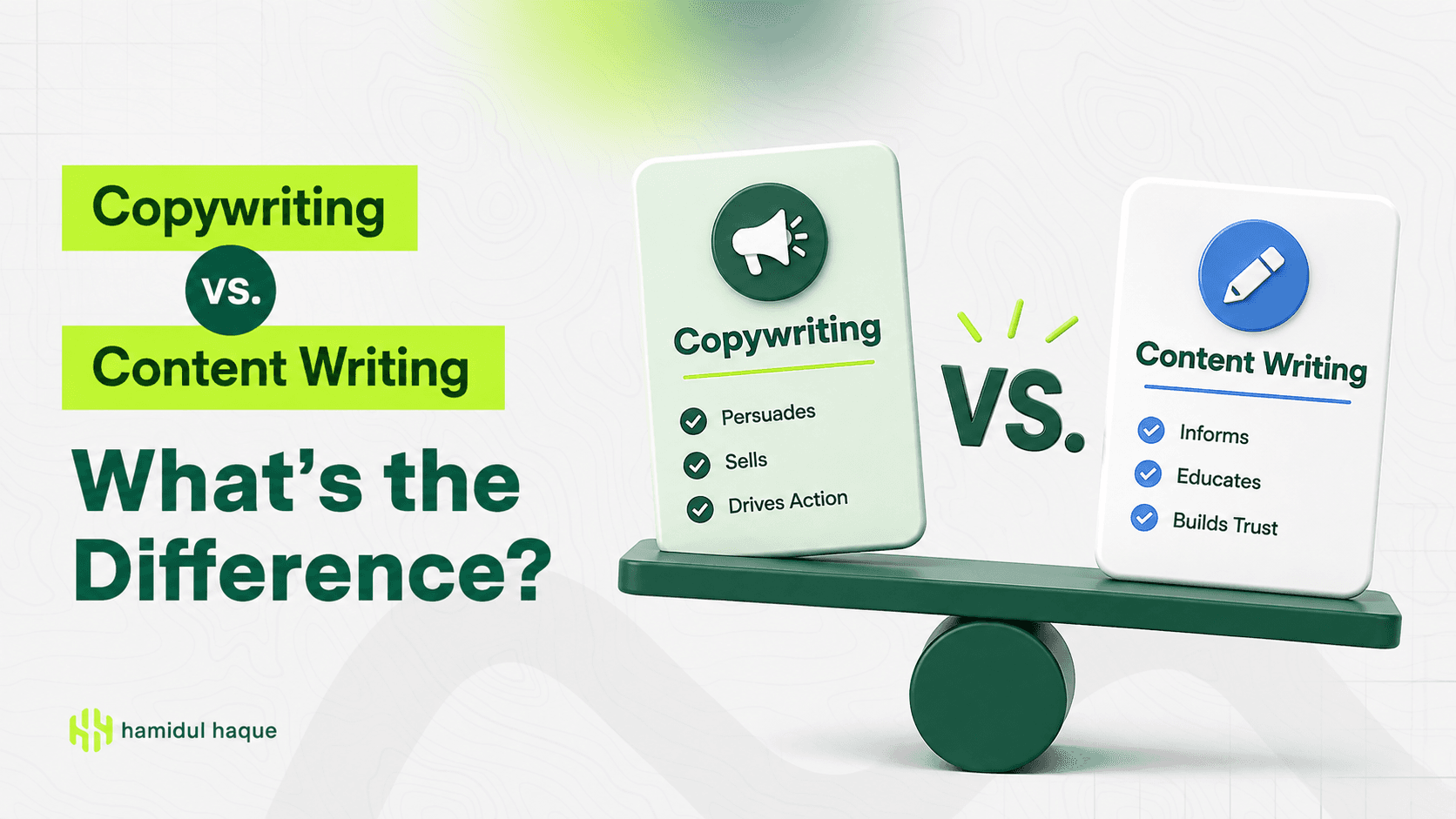
Copywriting and content writing are both used to communicate with an audience, but they have different primary goals. Copywriting is written to persuade someone to take an action, while content writing is primarily used to inform, educate, or build a relationship with the reader.
To put this in context, the content marketing industry is valued at over $600 billion globally, while digital advertising spend which heavily drives demand for copywriting also exceeds $600 billion annually, reflecting how both fields have become major parts of the global digital economy.
In this guide, I’ll compare copywriting vs. content writing by purpose, format, skills, SEO, conversion goals, and real-world use cases so you can understand which one you need and when.
Copywriting vs. Content Writing at a Glance
The main difference is intent. Copywriting is primarily written to persuade readers to take a specific action, while content writing is primarily created to inform, educate, attract, or nurture an audience.
| Area | Copywriting | Content Writing |
|---|---|---|
| Primary goal | Persuade and convert | Inform, educate, and build trust |
| Common formats | Landing pages, sales pages, ads, emails, product pages | Blog posts, guides, tutorials, reports, case studies |
| Reader intent | Often commercial or transactional | Often informational |
| CTA | Usually direct and important | Often softer or optional |
| SEO role | Can target commercial keywords | Commonly targets informational keywords |
| Typical success metrics | Conversion rate, leads, sales, CTR | Organic traffic, rankings, engagement, leads |
| Time horizon | Often focused on a specific action or campaign | Often supports longer-term audience and search growth |
| Core skills | Persuasion, positioning, offer development, CTA writing | Research, explanation, structure, SEO, topical knowledge |
What Is Copywriting?
Copywriting is writing created to persuade a reader to take a specific action, such as buying a product, booking a consultation, starting a free trial, subscribing, or clicking an ad. Semrush describes copywriting as persuasive writing that moves readers toward a decision, while Mailchimp similarly treats marketing copy as text designed to encourage action.
The action does not always have to be a purchase. For example:
- A Google Ad may try to earn a click.
- A landing page may try to generate a lead.
- A SaaS page may encourage users to start a free trial.
- An email may ask subscribers to register for a webinar.
- A product page may persuade shoppers to add an item to their cart.
Common Types of Copywriting
| Type | Primary Purpose |
|---|---|
| Landing page copy | Generate leads or conversions |
| Sales page copy | Persuade readers to purchase |
| Ad copy | Earn clicks or responses |
| Email copy | Encourage a specific action |
| Product page copy | Help shoppers decide to buy |
| Website copy | Communicate value and guide visitors |
| CTA copy | Prompt the next action |
Mailchimp, for example, treats subject lines, preview text, and email body content as parts of email copy because each can influence whether the recipient takes the intended action.
What Makes Good Copywriting?
Good copywriting usually makes four things clear:
- Who the offer is for
- What problem or need it addresses
- Why the offer is worth choosing
- What the reader should do next
A weak CTA might say:
Learn More
A more specific version could say:
Start Your 14-Day Free Trial
The second tells the reader exactly what happens after the click. This focus on clarity, persuasion, and action is what separates copywriting from writing that is primarily meant to inform.
What Is Content Writing?
Content writing is the process of creating written material to inform, educate, engage, or attract a specific audience. Common formats include blog posts, guides, ebooks, newsletters, case studies, and other educational resources.
Common Types of Content Writing
| Type | Primary Purpose |
|---|---|
| Blog posts | Answer questions and attract readers |
| How-to guides | Teach readers how to complete a task |
| Tutorials | Explain a process step by step |
| Case studies | Show how a problem was solved |
| Ebooks | Cover a topic in greater depth |
| Reports | Present research, findings, or industry data |
| Newsletters | Educate and nurture an existing audience |
| SEO articles | Answer search queries and earn organic visibility |
What Is Content Writing?
Content writing is the process of creating written material to inform, educate, engage, or attract a specific audience. Common formats include blog posts, guides, ebooks, newsletters, case studies, and other educational resources.
Common Types of Content Writing
Type
Primary Purpose
Blog posts
Answer questions and attract readers
How-to guides
Teach readers how to complete a task
Tutorials
Explain a process step by step
Case studies
Show how a problem was solved
Ebooks
Cover a topic in greater depth
Reports
Present research, findings, or industry data
Newsletters
Educate and nurture an existing audience
SEO articles
Answer search queries and earn organic visibility
What Makes Good Content Writing?
Effective content writing should:
- Match the reader's search intent
- Answer the main question clearly
- Provide accurate and useful information
- Use examples or evidence where needed
- Organize information so it is easy to scan
- Demonstrate genuine subject knowledge
- Help readers make a decision or take the next logical step
The Main Differences Between Copywriting and Content Writing
Copywriting and content writing can appear on the same website and even on the same page. The clearest way to separate them is by looking at what the writing is expected to achieve.
1. Copywriting Persuades, Content Writing Educates
Copywriting is written to move readers toward an action. Content writing is usually created to answer questions, explain a subject, or help readers solve a problem.
For example:
Copywriting: “Get 20% off your first order. Shop now.”
Content writing: “How to choose the right running shoes for your foot type.”
Both could be created by the same brand, but they serve different purposes.
2. Copywriting Usually Has a More Direct CTA
Because copywriting is conversion-focused, the next action is normally clear.
Nike product pages, for example, use “Add to Bag” after presenting the product, price, size options, and other purchase information. The copy supports a direct commercial action.
Content writing can also include CTAs, but the CTA is often secondary to answering the reader's question.
3. Content Writing Often Plays a Larger Role in SEO
Content writing is commonly used to target informational searches and create resources people can discover through search engines.
For example, HubSpot publishes educational articles around topics its target audience searches for. This allows the company to answer informational queries while building authority around marketing, sales, and related subjects.
Google also recommends creating people-first content that provides useful and reliable information rather than content designed primarily to manipulate rankings.
4. Copywriting Is Measured More Directly by Conversion
The metrics also differ because the objectives are different.
| Copywriting Metrics | Content Writing Metrics |
|---|---|
| Conversion rate | Organic traffic |
| Click-through rate | Search rankings |
| Leads generated | Engagement |
| Purchases | Time on page |
| Sign-ups | Backlinks |
| Revenue | Assisted conversions |
If I rewrite a landing-page headline, I would primarily look at whether the new version improves conversions. If I publish an informational article, I would pay more attention to visibility, traffic, engagement, and whether it satisfies the search intent.
5. The Writing Approach Is Different
| Area | Copywriting | Content Writing |
|---|---|---|
| Main question | “Why should I act?” | “What do I need to know?” |
| Focus | Benefits, offer, objections, action | Information, explanation, usefulness |
| CTA | Usually prominent | Often secondary |
| Research | Customer and offer research | Topic, audience, and search research |
| Structure | Built around persuasion | Built around understanding |
| Typical outcome | Conversion | Education, trust, or discovery |
The distinction is useful, but it is not absolute. A strong landing page may educate before asking for a conversion, while a useful blog post may include persuasive copy that encourages the reader to take the next step.
Copywriting and Content Writing Examples
The easiest way to understand the difference is to compare how the same business can use both.
| Business Need | Type | Example |
|---|---|---|
| Sell a pair of running shoes | Copywriting | Product page describing cushioning, comfort, and performance |
| Explain how to choose running shoes | Content writing | Educational buying guide |
| Get visitors to book a consultation | Copywriting | Service landing page |
| Explain how a service works | Content writing | Blog post or guide |
| Encourage software sign-ups | Copywriting | SaaS pricing or landing page |
| Teach users how to solve a problem | Content writing | Tutorial or knowledge article |
Nike provides a clear real-world example. Its Downshifter 14 product page highlights benefits such as increased cushioning, responsiveness, breathability, and a secure fit to help shoppers decide whether to buy the shoe. That is copywriting.
Nike also publishes a How to Choose Running Shoes guide covering factors such as fit, cushioning, terrain, running style, and mileage. The primary purpose is to help readers make a better choice, so this is content writing.
The same company therefore uses content to help customers understand their options and copy to move them closer to a purchase.
Can Content Writing Include Copywriting?
Yes. A piece of content can primarily educate the reader while still using copywriting to encourage a next step.
A blog post, for example, may explain a topic in detail and then use a CTA such as:
Download the free checklist
Start your free trial
Book a consultation
Content Marketing Institute recommends using clear calls to action within content because they can guide readers toward deeper engagement or conversion.
The key is the primary purpose of the page.
- If the main purpose is to answer a question or educate the reader, it is content writing.
- If the main purpose is to persuade the reader to take a commercial action, it is copywriting.
- If an educational article includes a persuasive CTA, it is still content writing with copywriting elements.
For example, a software company might publish a guide titled “How to Automate Your Sales Follow-Ups.” Most of the article could teach the process, while the final section encourages readers to try the company's software. The educational portion is content writing, while the CTA uses copywriting.
This overlap is common because useful content can attract and educate potential customers, while copywriting helps move interested readers toward the next action.
Should You Hire a Copywriter or a Content Writer?
Choose based on the outcome you need, not the job title.
Hire a Copywriter When You Need:
- Landing page copy
- Sales pages
- Google or social ads
- Product descriptions
- Email campaigns
- Website copy
- Stronger CTAs
- Higher conversion rates
If the main goal is to make visitors buy, book, sign up, request a quote, or take another specific action, I would hire a copywriter.
Hire a Content Writer When You Need:
- Blog posts
- SEO articles
- How-to guides
- Tutorials
- Thought-leadership content
- Case studies
- Educational newsletters
- Long-form resources
If the goal is to answer search queries, attract organic traffic, educate prospects, or build topical authority, a content writer is usually the better fit. Upwork makes a similar distinction, describing content writers as focused on informative material that builds trust, while copywriters focus more heavily on persuasive writing and conversion.
When You May Need Both
Many businesses need both skills because acquisition and conversion are separate problems.
HubSpot is a practical example. Its blog publishes educational resources designed to help readers understand marketing and related topics, while its product pages use conversion-focused messaging and CTAs such as getting started or requesting a demo.
For a SaaS company, that might look like this:
| Task | Better Fit |
|---|---|
| Write an SEO guide targeting “how to automate sales follow-ups” | Content writer |
| Write the software landing page | Copywriter |
| Create paid search ads | Copywriter |
| Publish a comparison or educational article | Content writer |
| Write an article CTA promoting the free trial | Copywriter |
If one writer can demonstrate strong work in both areas, a hybrid writer can be useful for projects such as SEO landing pages, product-led content, and conversion-focused blog content. The important part is whether they can handle both search intent and persuasion, not whether their title says “copywriter” or “content writer.”
Copywriting vs. Content Writing: Which Costs More?
Copywriting often costs more than general content writing because the work is tied more directly to leads, sales, and revenue. However, rates vary significantly based on experience, industry expertise, research requirements, and project complexity.
As a current marketplace benchmark, Upwork lists typical copywriter rates at $19 to $45 per hour, with a median of about $30 per hour. Content writers typically charge $15 to $40 per hour, with a median of about $25 per hour.
| Service | Typical Upwork Hourly Range |
|---|---|
| Copywriting | $19–$45/hour |
| Content writing | $15–$40/hour |
| SEO content writing | $15–$35/hour |
Upwork currently lists SEO content writers at approximately $15 to $35 per hour.
These figures are useful as marketplace benchmarks, not fixed industry prices. Experienced specialists can charge considerably more.
Why Copywriting Can Cost More
A copywriter may spend significant time on work that never appears in the final word count, including:
- Customer research
- Competitor research
- Offer positioning
- Value proposition development
- Objection research
- Headline and CTA variations
- Conversion-focused revisions
For example, a 700-word landing page may cost more than a 2,000-word blog post because the client is paying for the conversion strategy behind those 700 words, not simply the number of words written.
Content Writing Can Also Be Expensive
Content writing is not automatically the cheaper service. A writer producing technical, financial, legal, healthcare, or expert-led B2B content may charge significantly more because the work requires deeper subject knowledge and research.
Current 2026 market data also shows considerable variation in freelance writing rates depending on specialization and experience, with expert writers commanding substantially higher rates than generalists.
So, I would not choose between a copywriter and content writer based on price alone. Choose the writer based on the business outcome you need, then compare pricing among writers who can deliver that outcome.
Final Word
Copywriting and content writing serve different purposes, but they work best together. Content writing attracts, educates, and builds trust, while copywriting persuades readers to take action.
If you need traffic, education, or authority, focus on content writing. If you need leads, sales, or conversions, focus on copywriting. For most businesses, the strongest strategy uses both.


 Hamidul Haque
 Aug 23, 2026