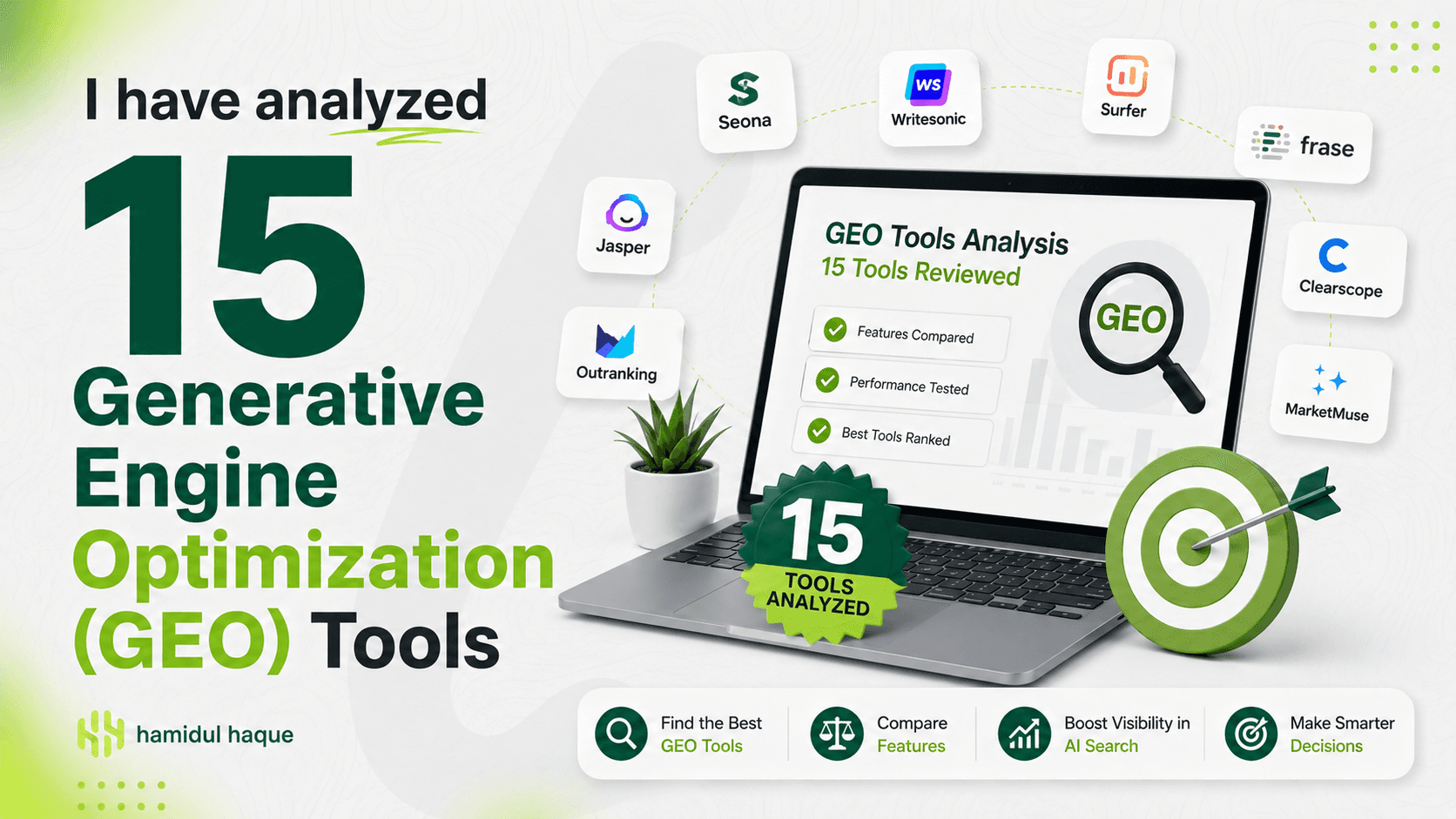
I analyzed 22 generative engine optimization tools to find the 15 strongest options for monitoring and improving visibility in AI-generated answers.
I compared each tool using publicly verifiable data, including supported AI engines, brand mention monitoring, citation tracking, competitor analysis, sentiment analysis, content recommendations, pricing and free-access options.
The analysis covers visibility across ChatGPT, Google AI Overviews, Google AI Mode, Gemini, Perplexity, Microsoft Copilot, Claude and other emerging AI platforms.
In this guide, I compare the 15 best candidates based on their GEO capabilities, AI platform coverage, pricing and publicly available product evidence. I also explain what each tool is best for, its important limitations and what to check before choosing it.
I have not yet conducted controlled hands-on accuracy or usability testing. Therefore, I treated missing information as undisclosed rather than assuming that a feature was unsupported. All public product data used in this analysis was reviewed in August 2026.
Key Findings From My Analysis
I analyzed publicly available data from 22 GEO tools. The strongest result was core GEO feature coverage, which averaged 91.8%. AI engine coverage was less consistent, averaging 70.5% across the platforms included in my analysis.
Pricing and product transparency remain major issues. Only 15 of the 22 tools published a starting price, and just six offered a free plan or free trial. On average, I could verify only 45% of the evaluated public-data fields.
The Best GEO Tools in 2026 at a Glance
I shortlisted 15 of the 22 tools based on their documented GEO features, AI engine coverage, pricing transparency, and evidence quality.
This table is a quick comparison of the shortlisted tools. The order reflects the preliminary public evidence score, not hands-on performance.
| GEO Tool | Best Fit Based on Public Evidence | Starting Price | AI Engines | Core Features | Free Access |
|---|---|---|---|---|---|
| Rankscale | Broad multi-engine tracking | €20/month | 8/8 | 5/5 | Free plan |
| Evertune | Enterprise-scale prompt monitoring | $800/month | 8/8 | 5/5 | No |
| Scrunch AI | Enterprise GEO and AI experience management | $250/month* | 8/8 | 5/5 | 7-day trial |
| OtterlyAI | Affordable GEO monitoring | $29/month | 7/8 | 5/5 | No |
| AthenaHQ | Free entry-level GEO analysis | Free | 7/8 | 5/5 | Free plan |
| Profound | Enterprise AI visibility intelligence | Custom | 8/8 | 5/5 | No |
| Peec AI | Marketing teams and agencies | €89/month | 6/8 | 5/5 | No |
| Writesonic GEO | Content teams and agencies | $249/month | 6/8 | 5/5 | No |
| AirOps | Content operations and GEO workflows | Custom | 6/8 | 5/5 | Free access available |
| Semrush AI Visibility Toolkit | Existing Semrush users | $99/month | 5/8 | 5/5 | No |
| SE Visible | Prompt tracking for SMBs and agencies | $99/month | 5/8 | 5/5 | 10-day trial |
| Ahrefs Brand Radar | SEO teams using Ahrefs data | $199/month | 6/8 | 4/5 | No |
| Bluefish | Large enterprise brands | Custom | 6/8 | 5/5 | No |
| Conductor AI Search Performance | Enterprise SEO programs | Custom | 6/8 | 5/5 | No |
| Omnia | Action-oriented AI search monitoring | Custom | 6/8 | 5/5 | No |
Scrunch AI’s $250 starting price came from vendor-comparison evidence because detailed current pricing was not available on its public website.
I found that Rankscale and Evertune received the highest preliminary public evidence scores. Both documented coverage for all eight evaluated AI engine groups and all five core GEO capabilities.
However, that does not establish either platform as the best-performing tool. I have not yet tested usability, recommendation quality, mention detection accuracy, citation detection accuracy, or reliability. These factors must be evaluated before I finalize the ranking.
Ranking disclosure: I created this shortlist from publicly verifiable product information reviewed in August 2026. A higher position indicates stronger documented capability and transparency, not proven hands-on performance. Prices and feature availability may vary by plan, billing cycle, and usage limits.
What Is Generative Engine Optimization (GEO)?
Generative engine optimization, or GEO, is the process of improving how often and how accurately a brand, product, website, or expert is mentioned and cited in AI-generated answers.
GEO focuses on platforms such as:
- ChatGPT
- Google AI Overviews
- Google AI Mode
- Gemini
- Perplexity
- Microsoft Copilot
- Claude
A successful GEO strategy can help a brand appear when users ask AI engines for recommendations, comparisons, explanations, or solutions. It also aims to increase citations from the brand’s website and improve how AI systems describe the brand.
GEO vs Traditional SEO
Traditional SEO improves a website’s visibility in search results. GEO improves a brand’s visibility within answers generated by AI systems.
| Area | Traditional SEO | GEO |
|---|---|---|
| Primary goal | Rank webpages in search results | Earn mentions and citations in AI answers |
| Main visibility | Organic listings and featured results | Generated responses and recommendations |
| Common metrics | Rankings, clicks, impressions, traffic | Mentions, citations, sentiment, AI Share of Voice |
| Typical optimization target | Keywords and webpages | Topics, entities, claims, sources, and prompts |
| Competitor analysis | Search-result rankings | Prompt-level brand visibility |
| Primary platforms | Google and Bing Search | ChatGPT, Google AI, Gemini, Perplexity, Copilot, and Claude |
GEO does not replace traditional SEO. AI engines often use search indexes, authoritative webpages, structured information, and trusted third-party sources when producing answers. Strong technical SEO, useful content, backlinks, and brand authority therefore continue to support AI visibility.
Businesses should treat SEO and GEO as connected strategies. SEO helps content become discoverable, while GEO focuses on whether AI systems mention, cite, and represent the brand accurately.
What Is a GEO Tool?
A GEO tool is software that monitors and analyzes a brand’s visibility across generative AI platforms.
Most GEO tools use a set of prompts to check whether an AI engine mentions the tracked brand, recommends its products, cites its website, or refers to competing brands. The tool then organizes those responses into measurable reports.
The five core capabilities I evaluated were:
- Brand mention monitoring: Identifies whether and how frequently AI answers mention a brand.
- Citation tracking: Records the websites, pages, and domains cited as sources.
- Competitor comparison: Compares brand visibility against selected competitors.
- Sentiment analysis: Evaluates whether mentions are positive, neutral, or negative.
- Content recommendations: Identifies topics, sources, or content improvements that may increase AI visibility.
Some platforms also provide prompt tracking, historical trends, location or language targeting, AI Share of Voice, reporting, exports, APIs, and integrations with existing SEO workflows.
Why Businesses Need GEO Tools in 2026
AI-generated answers can influence discovery before a user visits a website. A potential customer may ask an AI assistant to recommend software, compare products, find a service provider, or explain which brand is most suitable for a particular need.
Traditional analytics tools cannot fully measure this activity. Google Search Console can report search impressions and clicks, but it does not provide a complete view of brand mentions across ChatGPT, Perplexity, Claude, and other generative platforms.
GEO tools help close this measurement gap by showing:
- Which prompts produce a brand mention
- Which competitors appear more frequently
- Whether the brand is recommended or only referenced
- Which websites AI engines cite
- How visibility changes over time
- Whether answers describe the brand accurately
- Which topics may create new visibility opportunities
A dedicated GEO tool is most useful when AI discovery can influence revenue, reputation, product consideration, or competitor positioning. However, businesses should still verify tracked responses manually because AI outputs can vary by model, location, account, and testing time.
How I Analyzed and Compared the GEO Tools
I analyzed 22 GEO tools using publicly available product information. I reviewed each platform’s documented AI engine coverage, core GEO features, pricing, free-access options, and evidence transparency.
I used the same evaluation framework for every tool to keep the comparison consistent.
Tool Selection Criteria
I included a tool when I could verify that it offered dedicated functionality for monitoring or improving visibility in generative AI answers.
To qualify, a platform needed to provide evidence of at least one relevant capability, such as:
- AI brand mention monitoring
- Citation or source tracking
- Prompt-level visibility tracking
- AI competitor comparison
- AI Share of Voice measurement
- Sentiment analysis
- GEO content recommendations
I excluded general SEO tools when I could not verify a dedicated GEO or AI visibility feature.
Data Sources
I collected information from:
- Official product pages
- Official pricing pages
- Product documentation
- Vendor help centers
- Public feature descriptions
- Official announcements
- Other verifiable vendor resources
When official information was unavailable, I marked the field as undisclosed. I did not assume that an undocumented feature was unsupported.
Evaluation Criteria and Weighting
I calculated a preliminary public evidence score using four factors:
| Evaluation Factor | Weight | What I Evaluated |
|---|---|---|
| AI engine coverage | 40% | Number of verified AI engines supported |
| Core GEO feature coverage | 35% | Availability of the five evaluated GEO capabilities |
| Evidence quality | 15% | Strength and clarity of the supporting public evidence |
| Pricing transparency | 10% | Availability and clarity of public pricing information |
AI engine and feature coverage received the highest weights because they directly affect what a GEO tool can monitor and analyze.
AI Engines Included in My Analysis
I evaluated coverage across eight AI engine groups:
- ChatGPT
- Google AI Overviews
- Google AI Mode
- Gemini
- Perplexity
- Microsoft Copilot
- Claude
- Other emerging engines, including Grok, DeepSeek, and Meta AI
I counted an engine only when I found public evidence that the tool supported it. General claims such as “all major AI platforms” were not enough to verify every individual engine.
Core GEO Features I Evaluated
I evaluated five core capabilities:
- Brand mention monitoring: Tracks whether AI-generated answers mention a brand.
- Citation tracking: Identifies cited pages, domains, or sources.
- Competitor comparison: Compares visibility against competing brands.
- Sentiment analysis: Evaluates how AI platforms describe or recommend a brand.
- Content recommendations: Suggests actions that may improve AI visibility or citations.
I also recorded additional capabilities where evidence was available, including prompt tracking, historical reporting, location targeting, exports, APIs, and agency reporting.
How I Handled Pricing
I recorded the lowest publicly listed starting price that provided access to the relevant GEO functionality.
I applied the following rules:
- I kept monthly and annual billing distinctions where available.
- I did not treat custom pricing as free or $0.
- I separated permanent free plans from limited free trials.
- I noted when GEO functionality required an add-on.
- I treated unclear prompt, project, or usage allowances as undisclosed.
- I did not compare prices without considering relevant plan limitations.
Research Limitations
This analysis measures documented capabilities and public transparency. It does not yet measure real-world product performance.
I have not completed controlled hands-on testing of:
- Mention-detection accuracy
- Citation-detection accuracy
- Data reliability
- Prompt consistency
- Dashboard usability
- Reporting quality
- Recommendation usefulness
- Location and language accuracy
- Customer support
AI-generated responses can also change based on the model, prompt wording, location, account, and testing date.
For these reasons, the current order represents a preliminary public evidence ranking. I will not treat it as a definitive performance ranking until I test the shortlisted tools using the same brands, competitors, prompts, AI engines, locations, and testing period.
How GEO Tools Work
I found that most GEO tools follow a similar process. They run selected prompts across supported AI engines, collect the generated responses, and convert the results into visibility metrics.
1. Prompt Selection
The tool first creates or imports prompts that potential customers may use when researching a product, service, or topic.
Examples include:
- What are the best GEO tools?
- Which SEO platform offers AI visibility tracking?
- What is the best GEO tool for marketing agencies?
- Compare [Brand A] and [Brand B].
- Which companies provide [specific service]?
Some tools automatically suggest prompts based on a website, industry, topic, or competitor. Others allow users to upload a custom prompt set.
I consider custom prompt support important because generic prompts may not reflect the questions a brand’s actual audience asks.
2. AI Engine Monitoring
The tool submits those prompts to supported platforms such as:
- ChatGPT
- Google AI Overviews
- Google AI Mode
- Gemini
- Perplexity
- Microsoft Copilot
- Claude
Engine coverage varies considerably. In my dataset, the evaluated tools supported an average of 5.6 out of eight AI engine groups.
A higher engine count is useful only when those engines are relevant to the target audience. A company may receive more value from accurate monitoring across four important platforms than basic monitoring across eight.
3. Response Collection
The tool records the answers generated for each prompt. Depending on the platform and plan, the collected data may include:
- Complete AI responses
- Brand mentions
- Brand position within the answer
- Product recommendations
- Competitor mentions
- Cited URLs
- Cited domains
- Sentiment
- Response date
- Model or AI engine
- Location and language
Repeated collection is necessary because an AI engine may produce different answers for the same prompt.
4. Entity and Citation Detection
The platform analyzes each response to identify brands, products, competitors, sources, and links.
I separated mentions from citations in my analysis:
- A mention occurs when an AI answer names or discusses a brand.
- A citation occurs when the answer links to or identifies a source associated with the brand.
A brand can be mentioned without receiving a citation. A website can also be cited while its brand is not presented as a recommended option.
The strongest tools should report these outcomes separately.
5. Visibility Scoring
GEO tools convert collected responses into scores and trends. The calculation method differs by vendor, so scores from two tools should not be treated as directly equivalent.
Common metrics include:
- Mention rate
- Citation rate
- AI Share of Voice
- Average brand position
- Recommendation rate
- Sentiment score
- Prompt coverage
- Competitor visibility
- Visibility trend
The Main GEO Metrics I Evaluated
| Metric | What It Measures | Main Limitation |
| Mention rate | Percentage of tracked responses that mention the brand | A mention may be neutral or negative |
| Citation rate | Percentage of responses that cite the brand’s website or content | Citation formats vary by AI engine |
| AI Share of Voice | Brand visibility compared with selected competitors | Results depend on the prompt set |
| Average position | Where the brand appears within generated answers | Position does not always indicate preference |
| Recommendation rate | How often the brand is presented as a suitable option | Recommendation criteria may be unclear |
| Sentiment | Whether brand coverage is positive, neutral, or negative | Automated classification can miss context |
| Prompt coverage | Number of tracked prompts where the brand appears | A large prompt set may contain irrelevant queries |
| Source visibility | Domains and pages used by AI engines as sources | Some platforms do not expose complete citations |
6. Competitor Comparison
Most of the tools I analyzed compare a tracked brand with selected competitors.
This can show:
- Which competitor appears most frequently
- Which prompts competitors dominate
- Which domains receive the most citations
- How Share of Voice changes over time
- Where the tracked brand is absent
- Whether competitors receive more positive recommendations
The results are only meaningful when the competitor list and prompt set accurately represent the market.
7. Recommendations and Reporting
Some GEO tools stop at measurement. Others use the visibility data to recommend actions, such as:
- Creating content for uncovered topics
- Updating pages that AI engines already cite
- Improving entity clarity
- Adding supporting facts and expert evidence
- Targeting frequently cited third-party sources
- Addressing inaccurate brand descriptions
- Closing prompt-level visibility gaps
I consider a recommendation more useful when it connects to a specific prompt, response, competitor, or citation. Generic advice provides less value because it does not explain which observed visibility problem the action is intended to solve.
Reporting options may include dashboards, scheduled reports, CSV exports, APIs, and white-label client reports.
How Often GEO Tools Collect Data
Tracking frequency can range from daily monitoring to weekly or manually initiated checks. Higher-frequency tracking may reveal changes faster, but it can also increase prompt usage and subscription costs.
Before selecting a tool, I recommend checking:
- How often prompts are rerun
- Whether refresh frequency depends on the plan
- Whether historical responses are retained
- Whether users can request an immediate refresh
- Whether each rerun consumes additional credits
- Whether the model version and collection date are recorded
The 15 Best Generative Engine Optimization Tools in 2026
I shortlisted these 15 tools from the 22 platforms I analyzed. The ranking reflects publicly documented capabilities, AI engine coverage, pricing transparency, and evidence quality.
It does not represent a controlled hands-on performance ranking. I have clearly identified any pricing or capability that was undisclosed during my research.
1. Rankscale: Best for Affordable Multi-Engine GEO Tracking
Rankscale ranked first in my public-evidence analysis because I verified support for all eight evaluated AI engine groups and all five core GEO capabilities. It also had the lowest published starting price among the tools with similarly broad documented coverage.
Rankscale at a Glance
| Category | Details |
|---|---|
| Best for | Affordable multi-engine AI visibility tracking |
| Starting price | €20 per month |
| Free access | Free plan |
| Verified AI engine coverage | 8 of 8 |
| Verified core feature coverage | 5 of 5 |
| Main strength | Broad documented coverage at a low starting price |
| Main limitation | Hands-on accuracy and usability remain untested |
Key Features
I found public evidence for the following capabilities:
- Brand mention monitoring
- Citation and source tracking
- Competitor visibility analysis
- Sentiment analysis
- Content recommendations
- Prompt-level tracking
- Historical visibility reporting
- Multi-engine monitoring
Rankscale can be a practical starting point for small businesses, consultants, and agencies that want to monitor AI visibility without immediately paying for an enterprise platform.
Supported AI Engines
In my dataset, Rankscale covered all eight evaluated engine groups:
- ChatGPT
- Google AI Overviews
- Google AI Mode
- Gemini
- Perplexity
- Microsoft Copilot
- Claude
- Other emerging AI engines
This was one of the broadest publicly documented coverage levels in my comparison.
Pricing
Rankscale published a starting price of €20 per month and offered a free plan when I reviewed its public product information.
The low entry price makes it more accessible than many tools in this comparison. However, the subscription price alone does not show the complete cost.
Before choosing a plan, I recommend checking:
- Number of prompts included
- Number of tracked brands or projects
- Refresh frequency
- Historical-data limits
- Competitor limits
- Location and language support
- Export availability
- Additional credit costs
What I Like
- All eight AI engine groups were documented
- All five core GEO capabilities were documented
- A free plan was available
- The published starting price was comparatively low
- It combined mention, citation, competitor, sentiment, and content analysis
Important Limitations
I have not completed controlled hands-on testing of Rankscale. I therefore cannot confirm:
- Mention-detection accuracy
- Citation-detection accuracy
- Prompt repeatability
- Dashboard usability
- Data-refresh reliability
- Recommendation quality
- Customer-support quality
The broad feature list is promising, but documented coverage does not prove that every feature performs equally well.
Who Should Use Rankscale?
Rankscale appears best suited to:
- Small businesses starting GEO monitoring
- Independent SEO consultants
- Agencies testing AI visibility services
- Marketing teams that need broad engine coverage
- Users who want a free or low-cost entry point
Large enterprises may need to examine its reporting, permissions, integrations, API access, data governance, and support options before selecting it.
2. Evertune: Best for Enterprise-Scale Prompt Monitoring
I ranked Evertune second based on its publicly documented capabilities.
Key Data
- Best for: Enterprise-scale AI visibility monitoring
- Starting price: $800 per month
- Free plan or trial: Not publicly verified
- AI engine coverage: 8 of 8
- Core GEO feature coverage: 5 of 5
Supported AI Engines
- ChatGPT
- Google AI Overviews
- Google AI Mode
- Gemini
- Perplexity
- Microsoft Copilot
- Claude
- Other emerging AI engines
Key Features
- Brand mention monitoring
- Citation and source tracking
- Competitor analysis
- Sentiment analysis
- Content recommendations
- Prompt-level monitoring
- AI Share of Voice
- Historical trend analysis
- Multi-engine reporting
Strengths
- Complete documented AI engine coverage
- Complete core GEO feature coverage
- Enterprise-focused prompt monitoring
- Publicly listed starting price
Limitations
- High starting price
- No publicly verified free plan or trial
- I have not tested its accuracy, usability, or data reliability
3. Scrunch AI: Best for Enterprise GEO Management
I ranked Scrunch AI third based on its publicly documented capabilities.
Key Data
- Best for: Enterprise GEO and AI experience management
- Starting price: $250 per month
- Free plan or trial: 7-day trial
- AI engine coverage: 8 of 8
- Core GEO feature coverage: 5 of 5
Key Features
- Brand mention monitoring
- Citation tracking
- Competitor analysis
- Sentiment analysis
- Content recommendations
- Multi-engine visibility tracking
Strengths
- Complete documented AI engine coverage
- Complete core GEO feature coverage
- Enterprise-focused functionality
- Free trial available
Limitations
- The $250 price came from vendor-comparison evidence
- Detailed current pricing was not available on its public website
- I have not tested its accuracy, usability, or reliability
4. OtterlyAI: Best for Affordable GEO Monitoring
I ranked OtterlyAI fourth based on its documented feature coverage, AI engine support, and pricing.
Key Data
- Best for: Affordable GEO monitoring
- Starting price: $29 per month
- Free plan or trial: Not publicly verified
- AI engine coverage: 7 of 8
- Core GEO feature coverage: 5 of 5
Key Features
- Brand mention monitoring
- Citation tracking
- Competitor analysis
- Sentiment analysis
- Content recommendations
- Prompt-level visibility tracking
Strengths
- Seven verified AI engine groups
- Complete core GEO feature coverage
- Low published starting price
- Suitable for smaller teams
Limitations
- One evaluated AI engine group was not publicly verified
- No publicly verified free plan or trial
- I have not tested its accuracy, usability, or reliability
5. AthenaHQ: Best Free Entry-Level GEO Tool
I ranked AthenaHQ fifth based on its free access, documented features, and AI engine coverage.
Key Data
- Best for: Free entry-level GEO analysis
- Starting price: Free
- Free plan or trial: Free plan
- AI engine coverage: 7 of 8
- Core GEO feature coverage: 5 of 5
Key Features
- Brand mention monitoring
- Citation tracking
- Competitor analysis
- Sentiment analysis
- Content recommendations
- AI visibility reporting
Strengths
- Free plan available
- Seven verified AI engine groups
- Complete core GEO feature coverage
- Accessible starting point for GEO analysis
Limitations
- One evaluated AI engine group was not publicly verified
- Free-plan limits require verification
- I have not tested its accuracy, usability, or reliability
6. Profound: Best for Enterprise AI Visibility Intelligence
I ranked Profound sixth based on its complete documented engine and feature coverage.
Key Data
- Best for: Enterprise AI visibility intelligence
- Starting price: Custom
- Free plan or trial: Not publicly verified
- AI engine coverage: 8 of 8
- Core GEO feature coverage: 5 of 5
Key Features
- Brand mention monitoring
- Citation and source tracking
- Competitor analysis
- Sentiment analysis
- Content recommendations
- Multi-engine visibility intelligence
Strengths
- Complete documented AI engine coverage
- Complete core GEO feature coverage
- Enterprise-focused analysis
- Broad visibility and citation monitoring
Limitations
- No public starting price
- No publicly verified free plan or trial
- I have not tested its accuracy, usability, or reliability
7. Peec AI: Best for Marketing Teams and Agencies
I ranked Peec AI seventh based on its complete core feature coverage and documented support for six AI engine groups.
Key Data
- Best for: Marketing teams and agencies
- Starting price: €89 per month
- Free plan or trial: Not publicly verified
- AI engine coverage: 6 of 8
- Core GEO feature coverage: 5 of 5
Key Features
- Brand mention monitoring
- Citation tracking
- Competitor analysis
- Sentiment analysis
- Content recommendations
- AI Share of Voice tracking
Strengths
- Complete core GEO feature coverage
- Six verified AI engine groups
- Publicly listed starting price
- Suitable for agency and marketing workflows
Limitations
- Two evaluated AI engine groups were not publicly verified
- No publicly verified free plan or trial
- I have not tested its accuracy, usability, or reliability
8. Writesonic GEO: Best for Content Teams and Agencies
I ranked Writesonic GEO eighth based on its documented GEO features and integration with content workflows.
Key Data
- Best for: Content teams and agencies
- Starting price: $249 per month
- Free plan or trial: Not publicly verified
- AI engine coverage: 6 of 8
- Core GEO feature coverage: 5 of 5
Key Features
- Brand mention monitoring
- Citation tracking
- Competitor analysis
- Sentiment analysis
- Content recommendations
- AI visibility reporting
Strengths
- Complete core GEO feature coverage
- Six verified AI engine groups
- Publicly listed starting price
- GEO data connected with content optimization
Limitations
- Two evaluated AI engine groups were not publicly verified
- High starting price for smaller teams
- No publicly verified free plan or trial
- I have not tested its accuracy, usability, or reliability
9. AirOps: Best for GEO Content Workflows
I ranked AirOps ninth based on its documented GEO features and content workflow capabilities.
Key Data
- Best for: Content operations and GEO workflows
- Starting price: Custom
- Free plan or trial: Free access available
- AI engine coverage: 6 of 8
- Core GEO feature coverage: 5 of 5
Key Features
- Brand mention monitoring
- Citation tracking
- Competitor analysis
- Sentiment analysis
- Content recommendations
- Automated content workflows
Strengths
- Complete core GEO feature coverage
- Six verified AI engine groups
- Free access available
- Combines GEO analysis with content operations
Limitations
- No public starting price
- Two AI engine groups were not publicly verified
- Free-access limits require verification
- I have not tested its accuracy, usability, or reliability
10. Semrush AI Visibility Toolkit: Best for Existing Semrush Users
I ranked Semrush AI Visibility Toolkit tenth based on its documented GEO features and integration with the Semrush platform.
Key Data
- Best for: Existing Semrush users
- Starting price: $99 per month
- Free plan or trial: Not publicly verified
- AI engine coverage: 5 of 8
- Core GEO feature coverage: 5 of 5
Key Features
- Brand mention monitoring
- Citation tracking
- Competitor analysis
- Sentiment analysis
- Content recommendations
- AI visibility reporting
Strengths
- Complete core GEO feature coverage
- Publicly listed starting price
- Integration with existing Semrush workflows
- Suitable for SEO and marketing teams
Limitations
- Three AI engine groups were not publicly verified
- No publicly verified free plan or trial
- May add extra cost for existing Semrush users
- I have not tested its accuracy, usability, or reliability
11. SE Visible: Best for SMB and Agency Prompt Tracking
I ranked SE Visible eleventh based on its documented prompt-tracking capabilities and complete core feature coverage.
Key Data
- Best for: Prompt tracking for SMBs and agencies
- Starting price: $99 per month
- Free plan or trial: 10-day trial
- AI engine coverage: 5 of 8
- Core GEO feature coverage: 5 of 5
Key Features
- Brand mention monitoring
- Citation tracking
- Competitor analysis
- Sentiment analysis
- Content recommendations
- Prompt-level visibility tracking
Strengths
- Complete core GEO feature coverage
- Publicly listed starting price
- 10-day trial available
- Suitable for agencies and smaller businesses
Limitations
- Three AI engine groups were not publicly verified
- No permanent free plan was verified
- Trial limits require verification
- I have not tested its accuracy, usability, or reliability
12. Ahrefs Brand Radar: Best for Ahrefs Users
I ranked Ahrefs Brand Radar twelfth based on its AI visibility data and integration with the Ahrefs platform.
Key Data
- Best for: SEO teams using Ahrefs data
- Starting price: $199 per month
- Free plan or trial: Not publicly verified
- AI engine coverage: 6 of 8
- Core GEO feature coverage: 4 of 5
Key Features
- Brand mention monitoring
- Citation and source tracking
- Competitor analysis
- AI Share of Voice
- Historical visibility reporting
- Integration with Ahrefs data
Strengths
- Six verified AI engine groups
- Publicly listed starting price
- Strong connection with SEO and web data
- Suitable for existing Ahrefs workflows
Limitations
- One core GEO feature was not publicly verified
- Two AI engine groups were not publicly verified
- No publicly verified free plan or trial
- I have not tested its accuracy, usability, or reliability
13. Bluefish: Best for Large Enterprise Brands
I ranked Bluefish thirteenth based on its enterprise positioning and complete documented core feature coverage.
Key Data
- Best for: Large enterprise brands
- Starting price: Custom
- Free plan or trial: Not publicly verified
- AI engine coverage: 6 of 8
- Core GEO feature coverage: 5 of 5
Key Features
- Brand mention monitoring
- Citation tracking
- Competitor analysis
- Sentiment analysis
- Content recommendations
- Enterprise AI visibility reporting
Strengths
- Complete core GEO feature coverage
- Six verified AI engine groups
- Enterprise-focused functionality
- Brand and competitor intelligence
Limitations
- No public starting price
- Two AI engine groups were not publicly verified
- No publicly verified free plan or trial
- I have not tested its accuracy, usability, or reliability
14. Conductor AI Search Performance: Best for Enterprise SEO Programs
I ranked Conductor AI Search Performance fourteenth based on its documented GEO capabilities and connection with enterprise SEO workflows.
Key Data
- Best for: Enterprise SEO programs
- Starting price: Custom
- Free plan or trial: Not publicly verified
- AI engine coverage: 6 of 8
- Core GEO feature coverage: 5 of 5
Key Features
- Brand mention monitoring
- Citation tracking
- Competitor analysis
- Sentiment analysis
- Content recommendations
- AI search performance reporting
Strengths
- Complete core GEO feature coverage
- Six verified AI engine groups
- Integration with enterprise SEO workflows
- Suitable for large marketing teams
Limitations
- No public starting price
- Two AI engine groups were not publicly verified
- No publicly verified free plan or trial
- I have not tested its accuracy, usability, or reliability
15. Omnia: Best for Action-Oriented AI Search Monitoring
I ranked Omnia fifteenth based on its documented GEO features and action-oriented visibility analysis.
Key Data
- Best for: Action-oriented AI search monitoring
- Starting price: Custom
- Free plan or trial: Not publicly verified
- AI engine coverage: 6 of 8
- Core GEO feature coverage: 5 of 5
Key Features
- Brand mention monitoring
- Citation tracking
- Competitor analysis
- Sentiment analysis
- Content recommendations
- AI search visibility reporting
Strengths
- Complete core GEO feature coverage
- Six verified AI engine groups
- Combines visibility monitoring with recommended actions
- Suitable for brands and marketing teams
Limitations
- No publicly listed starting price
- Two AI engine groups were not publicly verified
- No publicly verified free plan or trial
- I have not tested its accuracy, usability, or reliability
How to Choose the Best GEO Tool
I recommend comparing GEO tools using the following factors:
AI Engine Coverage
Check whether the tool monitors the AI platforms your audience uses, such as:
- ChatGPT
- Google AI Overviews
- Google AI Mode
- Gemini
- Perplexity
- Microsoft Copilot
- Claude
Core GEO Features
I evaluated five core features:
- Brand mention monitoring
- Citation tracking
- Competitor analysis
- Sentiment analysis
- Content recommendations
Prompt Limits
Check:
- Number of prompts included
- Prompt refresh frequency
- Additional prompt costs
- Custom prompt support
- Location and language options
Data Quality
The tool should provide:
- Original AI responses
- Collection dates
- AI engine or model details
- Mention and citation records
- Historical data
- Exportable reports
Pricing
Compare the total cost based on:
- Monthly subscription
- Included projects
- Included competitors
- Prompt allowances
- User limits
- API access
- Additional usage fees
Free Access
Only six of the 22 tools I analyzed offered a publicly verified free plan or trial. I recommend testing the available free version before purchasing when possible.
Best Tool by Use Case
- Affordable multi-engine tracking: Rankscale
- Enterprise prompt monitoring: Evertune
- Enterprise GEO management: Scrunch AI
- Affordable GEO monitoring: OtterlyAI
- Free entry-level analysis: AthenaHQ
- Enterprise visibility intelligence: Profound
- Agencies and marketing teams: Peec AI
- Content optimization workflows: Writesonic GEO
- Automated content operations: AirOps
- Existing Semrush users: Semrush AI Visibility Toolkit
- Existing Ahrefs users: Ahrefs Brand Radar
I would not select a GEO tool using engine count or price alone. Prompt limits, tracking frequency, data quality, and relevant platform coverage determine the tool’s actual value.
How Much Do GEO Tools Cost?
I found that the 15 shortlisted GEO tools cost between $0 and $800 per month, excluding tools with custom pricing.
Published Starting Prices
AthenaHQ offers a free plan. Rankscale starts at €20 per month, OtterlyAI at $29, Peec AI at €89, Semrush AI Visibility Toolkit and SE Visible at $99, Ahrefs Brand Radar at $199, Writesonic GEO at $249, Scrunch AI at $250, and Evertune at $800 per month.
Tools With Custom Pricing
AirOps, Profound, Bluefish, Conductor AI Search Performance, and Omnia do not publish fixed starting prices.
Free Plans and Trials
Rankscale and AthenaHQ offer free plans. Scrunch AI offers a 7-day trial, while SE Visible offers a 10-day trial. AirOps also provides free access, but I could not verify its usage limits.
Additional Costs
The total cost can vary based on prompt limits, tracking frequency, supported AI engines, projects, competitors, locations, users, historical data, exports, API access, and additional usage credits.
Scrunch AI’s $250 starting price came from third-party vendor-comparison evidence because I could not verify current pricing on its official website.
Are GEO Tools Worth It?
GEO tools are useful when a business needs to track brand visibility across several AI platforms, prompts, and competitors. They automate data collection that would take considerably longer to complete manually.
When a Paid GEO Tool Is Worth It
A paid tool is suitable for brands, agencies, and marketing teams that need regular monitoring, historical data, competitor comparisons, citation tracking, and downloadable reports.
Paid monitoring is more valuable when AI recommendations influence leads, sales, reputation, or purchasing decisions.
When a Free Tool Is Enough
A free plan may be sufficient for a small business or individual tracking a limited number of prompts. Rankscale and AthenaHQ provide free plans, while Scrunch AI and SE Visible offer limited trials.
Manual testing may also be enough when only a few prompts and AI engines need to be checked.
Key Limitation
GEO tool results depend on the prompts, AI engines, locations, models, and collection frequency used. Different tools may report different visibility scores for the same brand.
I recommend checking the original AI responses instead of relying only on a platform’s calculated visibility score.
Can I Track AI Visibility Without a GEO Tool?
I can track AI visibility manually by testing relevant prompts across ChatGPT, Google AI Overviews, Gemini, Perplexity, Copilot, and Claude.
Manual Tracking Process
I enter the same prompts into each AI engine and record whether the response mentions my brand, cites my website, recommends competitors, and describes the brand positively or negatively.
I can organize the results in a spreadsheet with columns for the prompt, AI engine, date, brand mention, citation, competitors, sentiment, and response URL.
Advantages of Manual Tracking
Manual tracking is free and allows me to inspect the original AI responses directly. It is suitable for testing a small number of prompts or validating data reported by a GEO tool.
Limitations of Manual Tracking
The process becomes difficult when I need to monitor hundreds of prompts, multiple competitors, several locations, or historical changes. AI responses can also vary between tests, accounts, models, and locations.
When I Would Use a GEO Tool
I would use manual tracking for a small initial test. I would choose a GEO tool when I need scheduled monitoring, competitor comparisons, citation analysis, historical trends, and reporting across a larger prompt set.
Final Thoughts
I ranked Rankscale as the best overall GEO tool based on publicly documented data. It supports eight AI engine groups, covers all five core GEO features, starts at €20 per month, and offers a free plan.
Best Options by Need
Rankscale is the best affordable option, Evertune is suitable for enterprise-scale monitoring, OtterlyAI offers low-cost paid tracking, and AthenaHQ provides a free entry point. Peec AI is suitable for marketing agencies, while Semrush AI Visibility Toolkit and Ahrefs Brand Radar fit existing users of those platforms.
My Recommendation
I would start with a free plan or trial and test the tool using the same prompts, competitors, and AI engines. I would also compare its mention and citation data with the original AI responses before purchasing a paid plan.
Pricing, features, and engine coverage can change. I recommend verifying the latest plan details on each tool’s official website before making a final decision.


 Hamidul Haque
 Aug 23, 2026