Some readers don't need to be convinced they have a problem. They already feel it every day. What they need is proof that you understand it better than anyone else, and a clear way out.
That's exactly what the PAS formula does. In this guide, I'll explain the three steps of Problem, Agitate, Solution, show you seven PAS examples for landing pages, emails, ads and more, and give you a free fill-in template so you can write your own in minutes.
What Is the PAS Formula?
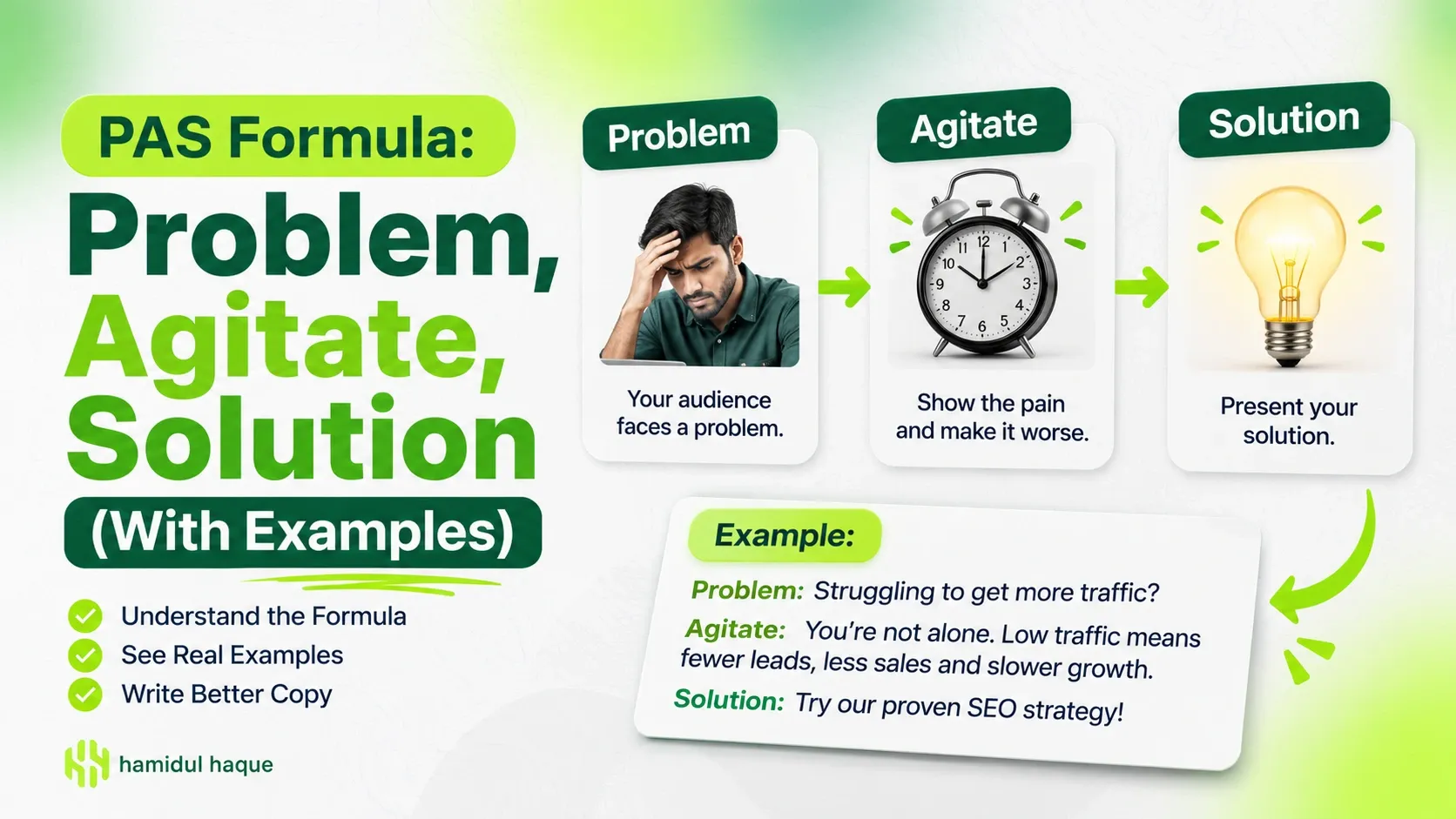
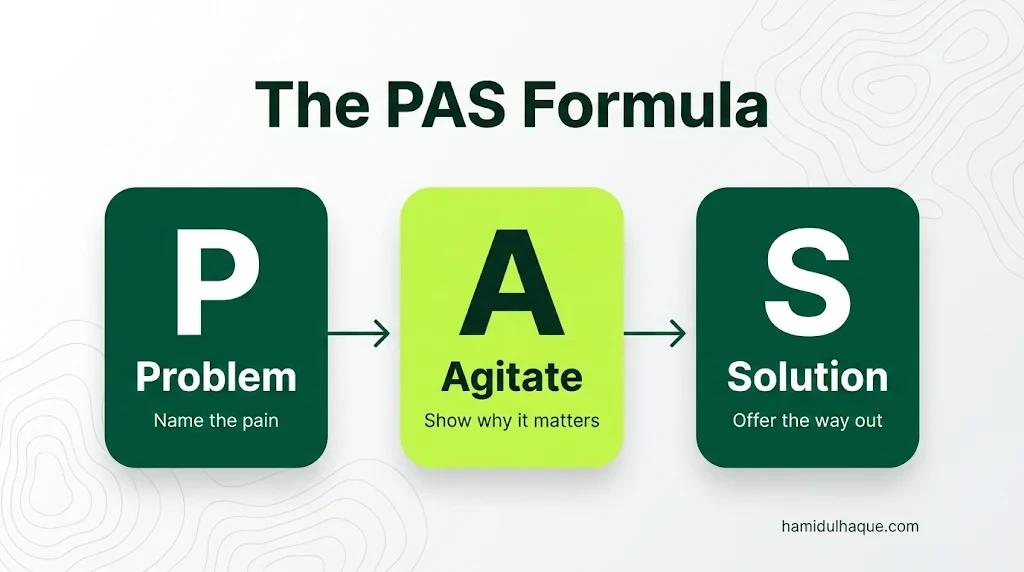
PAS is a copywriting formula with three steps: Problem, Agitate, Solution. You name a problem the reader already has, make them feel why it matters, then present your offer as the way to fix it.
It's one of the oldest structures in direct-response copywriting. Nobody knows for certain who first named it, but it has been passed between copywriters for decades because it's short, flexible and works on almost any channel.
| Step | The reader's thought | Your job |
|---|---|---|
| Problem | That's exactly my situation. | Name one specific pain in their words |
| Agitate | This is costing me more than I thought. | Show the consequences and why it matters now |
| Solution | This could actually fix it. | Present the offer, proof and one next step |
Why the PAS Formula Works
PAS works because it starts where the reader already is. Instead of earning attention with a clever line, it opens with something they're already thinking about.
It also uses a well-documented quirk of human decision-making. In their 1979 paper on prospect theory, Daniel Kahneman and Amos Tversky showed that people react more strongly to losses than to equivalent gains. Describing what the problem costs the reader, in time, money or stress, is often more motivating than listing what they'll gain.
That's why PAS is a strong fit for problem-aware readers: people who know something is wrong but haven't chosen a fix yet. For readers who don't know you or their problem yet, the AIDA formula is often a better starting point.
The 3 Steps of PAS, Explained
1. Problem: Name the Pain Precisely
Start with one specific problem in the reader's own words. The more precise it is, the faster the reader thinks, "That's me."
- Weak: "Struggling with marketing?"
- Strong: "You post on LinkedIn three times a week and still haven't had a single enquiry."
Pull the wording from reviews, sales calls, support tickets and forums. If you only have one sentence for the problem, choose the most painful, most common version of it.
2. Agitate: Show Why It Matters
Agitation is where you make the problem feel real and urgent. Describe the consequences: what it costs, what it blocks, how it feels, and what happens if nothing changes.
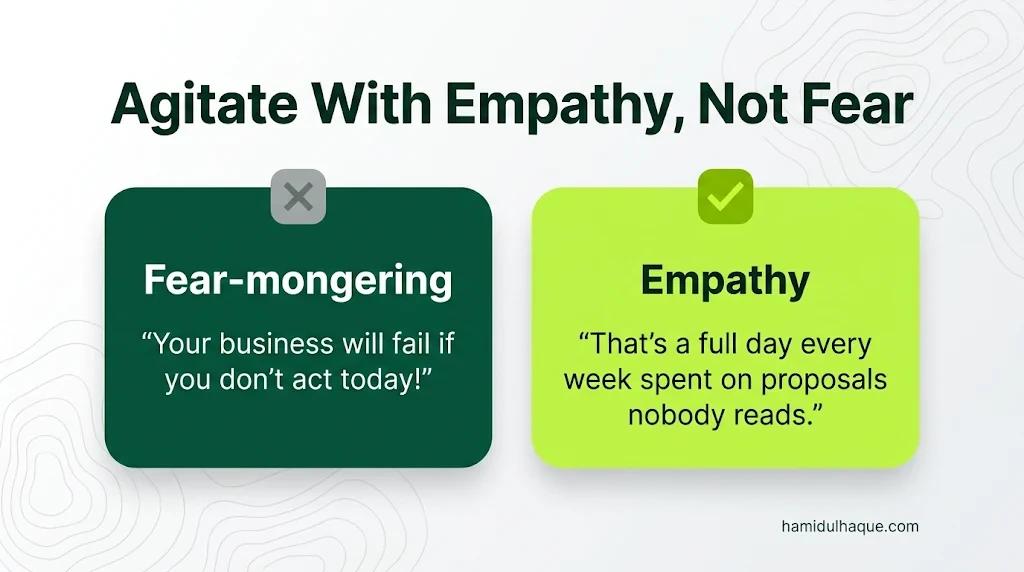
Good agitation is empathy, not fear-mongering. You're showing the reader that you understand their situation in detail, not inventing a crisis. A useful test is whether the reader would nod along or roll their eyes.
3. Solution: Offer a Clear Way Out
Now introduce your product, service or idea as the answer. Connect it directly to the problem you described, show proof that it works, and end with one clear next step.
The solution should feel like relief. If the agitation built tension, this is where you release it with specifics: how it works, what changes and how quickly. My list of call to action examples can help you finish with the right button.
7 PAS Formula Examples
The examples below use fictional products so you can see the structure clearly. Each one follows the same three steps in a different format.
PAS Landing Page Example
Problem: Your proposals take three hours to write, and half of them never get a reply.
Agitate: That's a full working day every week spent on documents nobody reads, while competitors who reply faster win the work.
Solution: Pitchly turns your notes into a polished proposal in 10 minutes, with pricing tables and e-signatures built in. Send your first proposal free.
PAS Cold Email Example
Problem: Hi Sara, I noticed your product pages don't show delivery times until checkout.
Agitate: When shoppers find surprise costs or delays at the last step, many leave without buying, and you've already paid to bring them there.
Solution: We help Shopify stores show delivery dates on every product page. Can I send you a two-minute video showing how it would look on your store?
PAS Facebook or LinkedIn Ad Example
Problem: Still chasing clients for late invoices?
Agitate: Every week you wait for payment, your rent, tools and taxes are still due.
Solution: Ledgerly sends polite reminders for you, and clients pay in one click. Try it free.
PAS Product Description Example
Problem: Most office chairs feel fine for an hour, then your lower back starts to ache.
Agitate: By mid-afternoon you're shifting every few minutes, and by Friday the pain follows you home.
Solution: The Arc chair's adjustable lumbar support keeps your spine in a natural curve all day. 30-night free trial.
PAS Social Media Post Example
Problem: Your blog gets traffic but no enquiries.
Agitate: You're paying for content that educates readers, then sends them straight to a competitor to buy.
Solution: Add one clear next step to every post: a template, a checklist or a short call. Here's how I do it.
PAS Service Page Example
Problem: Your website looks good, but visitors leave without getting in touch.
Agitate: Every visitor who leaves confused is a lead you paid for and lost, and the problem compounds every month.
Solution: I rewrite your key pages around what your buyers actually ask, so the right people understand your offer and act. Book a free 15-minute review.
PAS Headline and Subheadline Example
PAS can also work in just two lines at the top of a page:
Headline: Stop losing leads to slow follow-up.
Subheadline: Every hour you wait cuts your chance of a reply. Our inbox assistant drafts the response in seconds, so you answer first.
Get the Free PAS Template
A Google Sheet with prompts for each PAS step, all 7 examples from this guide and space to draft your own. Make a copy and reuse it for every page, email or ad.
Copy the Template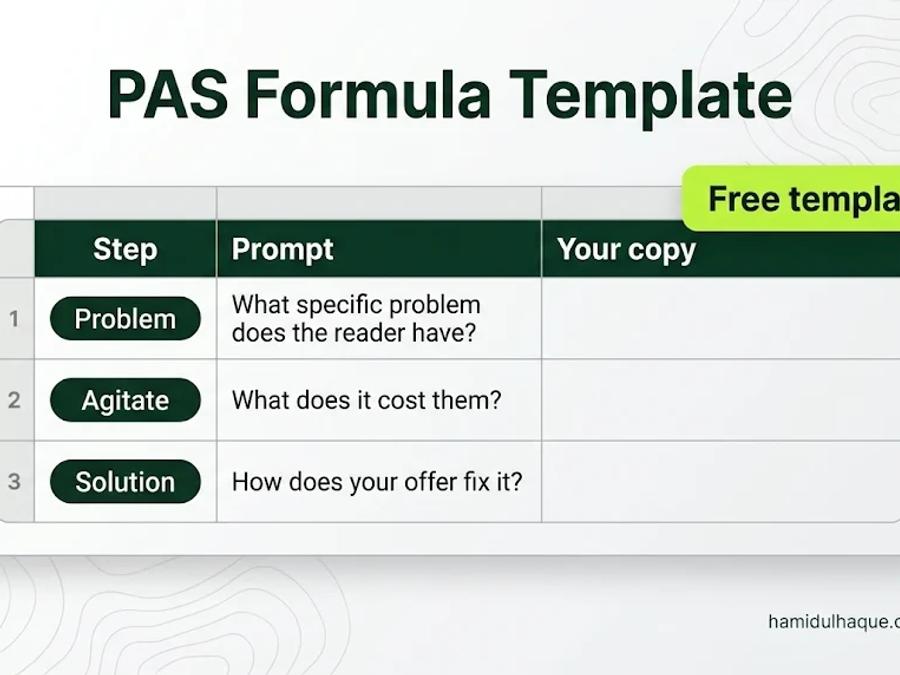
Free PAS Template
Fill in each row before you write the full piece. If you can't complete a row in one or two sentences, that part of your message needs more research, not more words.
| Step | Prompt to answer | Your copy |
|---|---|---|
| Problem | What specific problem does the reader have, in their own words? | ... |
| Agitate | What does it cost them in time, money or stress? What happens if nothing changes? | ... |
| Solution | How does your offer fix it, what proof do you have, and what's the next step? | ... |
PAS vs AIDA vs BAB
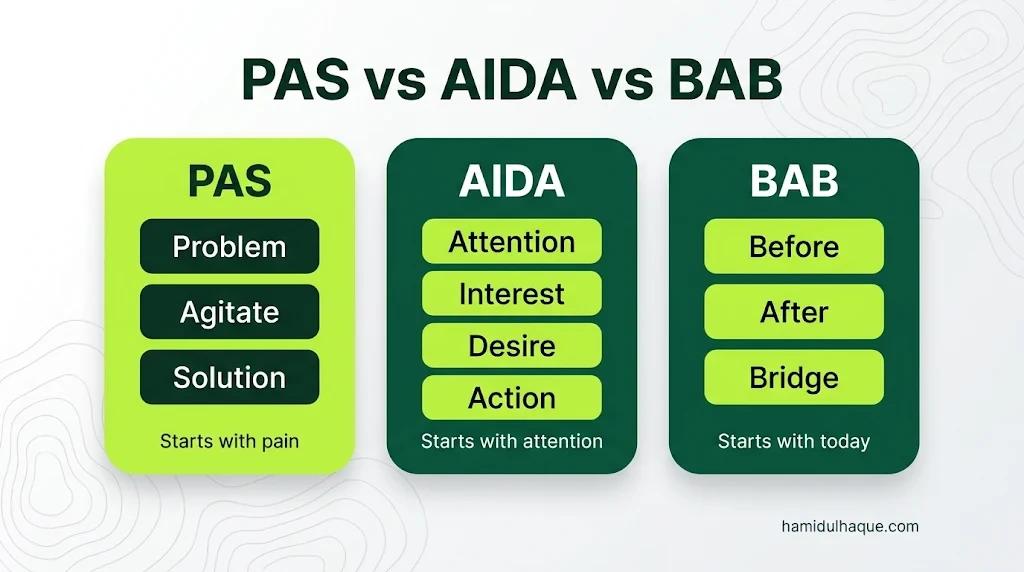
PAS is one of three classic short formulas. Here's how they compare:
| Formula | Starts with | Best for |
|---|---|---|
| PAS (Problem, Agitate, Solution) | A pain the reader already feels | Problem-aware readers; emails, ads, service pages |
| AIDA (Attention, Interest, Desire, Action) | Earning attention | Readers who don't know you yet; landing pages |
| BAB (Before, After, Bridge) | The reader's current situation | Showing a transformation; social posts, case studies |
Many pages combine them. A landing page can use AIDA for its overall structure and PAS inside the problem section. For more options, see my guide to 20+ copywriting formulas.
PAS Variations
- PASO (Problem, Agitate, Solution, Outcome) adds a final step that shows the result the reader will enjoy once the problem is solved. It's useful when the outcome is the real selling point.
- PAS with proof places testimonials, numbers or a case study between the solution and the call to action. It helps when the reader is sceptical or the purchase is expensive.
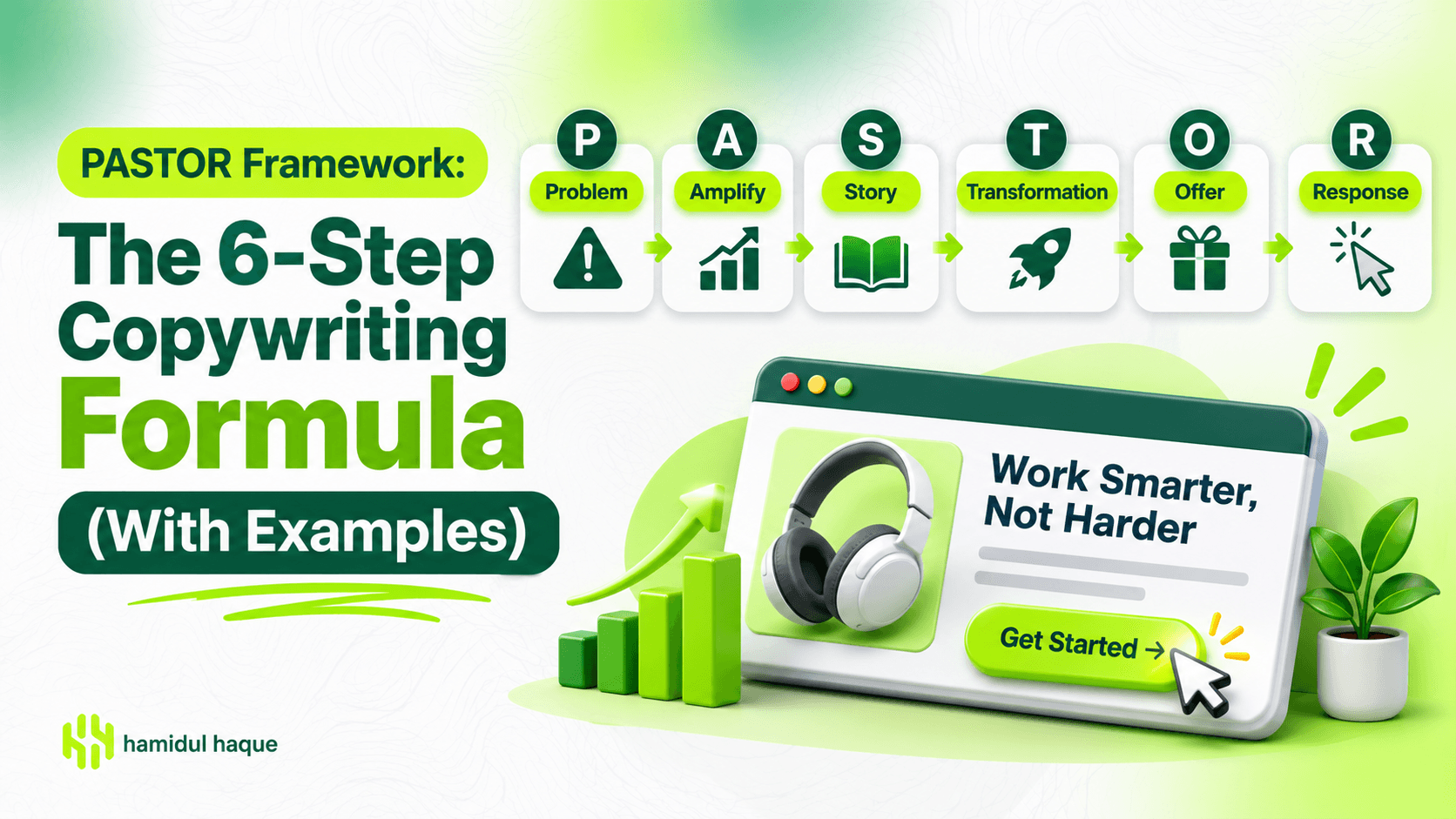
- PASTOR (Problem, Amplify, Story, Transformation, Offer, Response) turns PAS into a full long-form structure with a true story, testimonials and a detailed offer. It suits sales pages and sales emails.
Common PAS Mistakes
- Agitating too hard. Exaggerated fear damages trust. Describe real consequences, not worst-case disasters.
- Picking a problem the reader doesn't have. If the problem isn't real for them, the whole structure falls apart.
- A vague solution. "We can help" isn't a solution. Explain what you do and what changes.
- No proof. After agitation, readers want evidence. Add a result, a review or a demonstration.
- No clear next step. End with one specific action, not a list of options.
Final Thoughts
PAS is simple: name the problem, make it matter, then offer a clear way out. Used with empathy and specific detail, it's one of the fastest ways to write copy that makes the right reader feel understood.
Copy the free template and try it on your next email, ad or service page. Before you publish, run the page through my website copy checklist. If you'd like help writing problem-led pages that convert, take a look at my SEO copywriting service.


 Hamidul Haque
 Nov 22, 2026