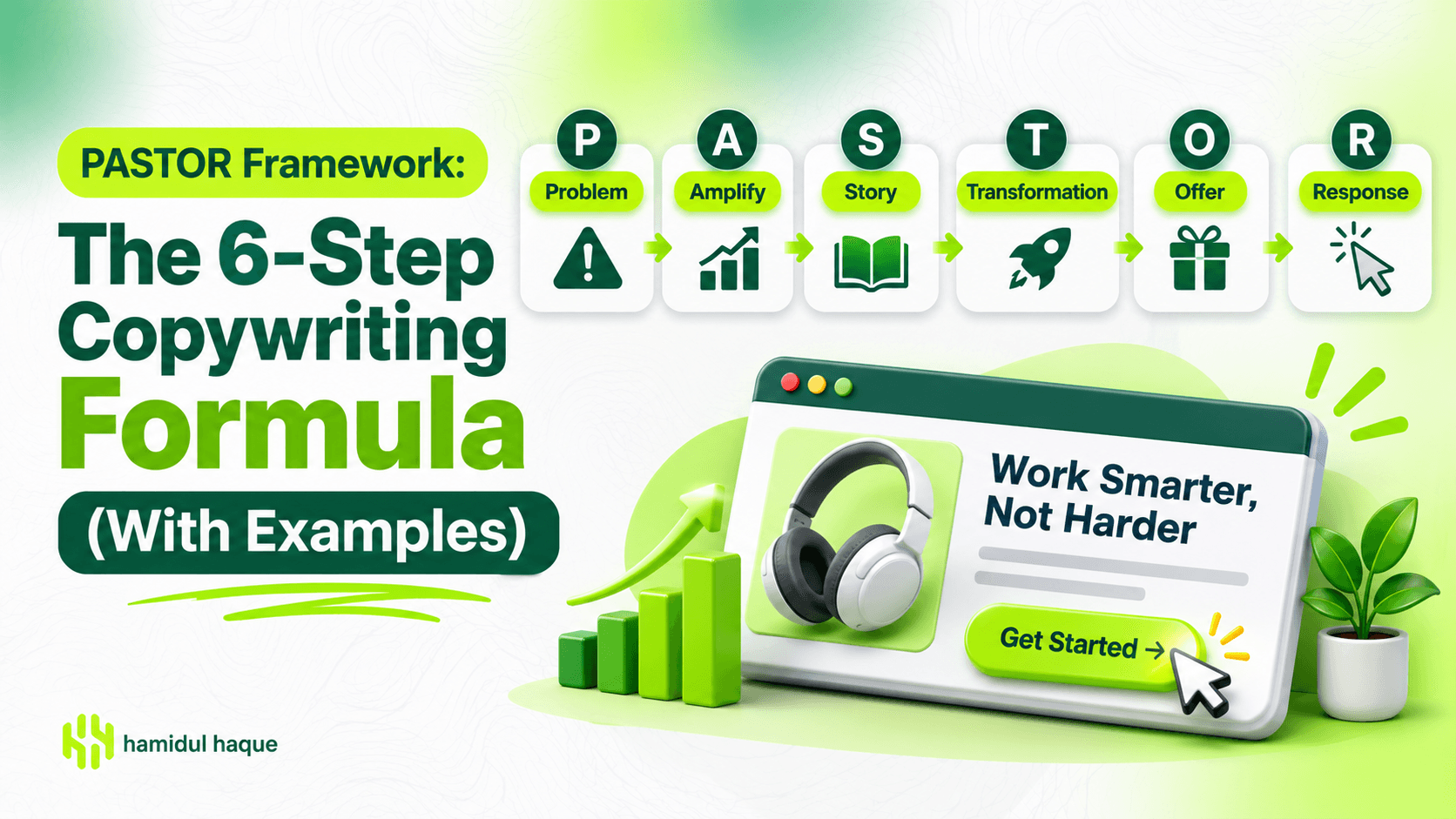
Some products need more than a headline and a button. If you're selling a course, a coaching programme or a high-ticket service, the reader needs to feel understood, see that change is possible and know exactly what they're getting before they say yes. The PASTOR framework gives you a structure for that kind of longer copy.
This guide explains each of the six PASTOR steps (Problem, Amplify, Story, Transformation, Offer, Response) with weak and strong examples, a full sales email written with the formula, and a free Google Sheet template you can copy and fill in.
What Is the PASTOR Framework?
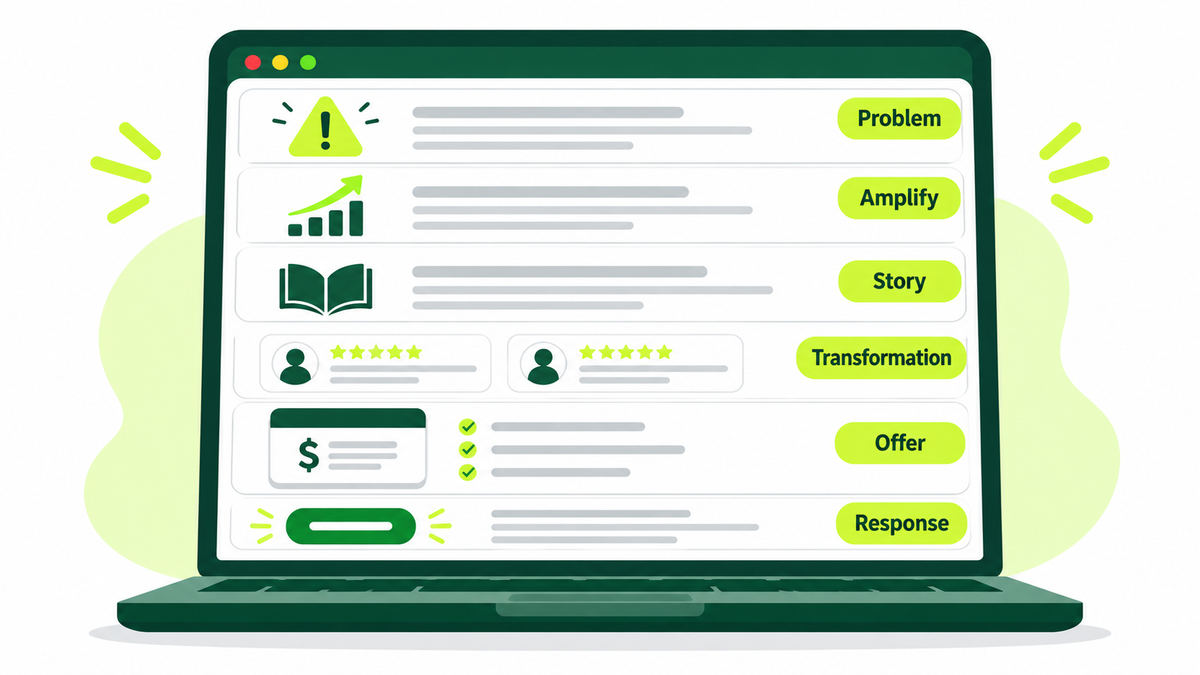
The PASTOR framework is a six-step copywriting formula created by copywriter Ray Edwards. Each letter stands for one part of a persuasive message: Problem, Amplify, Story and Solution, Transformation and Testimony, Offer and Response. You name the reader's problem, show what it costs them, tell a story that leads to a solution, prove the change is real, lay out the offer and ask for one clear action.
You'll also see it called the PASTOR method or the PASTOR copywriting formula. All three names mean the same six-step structure.
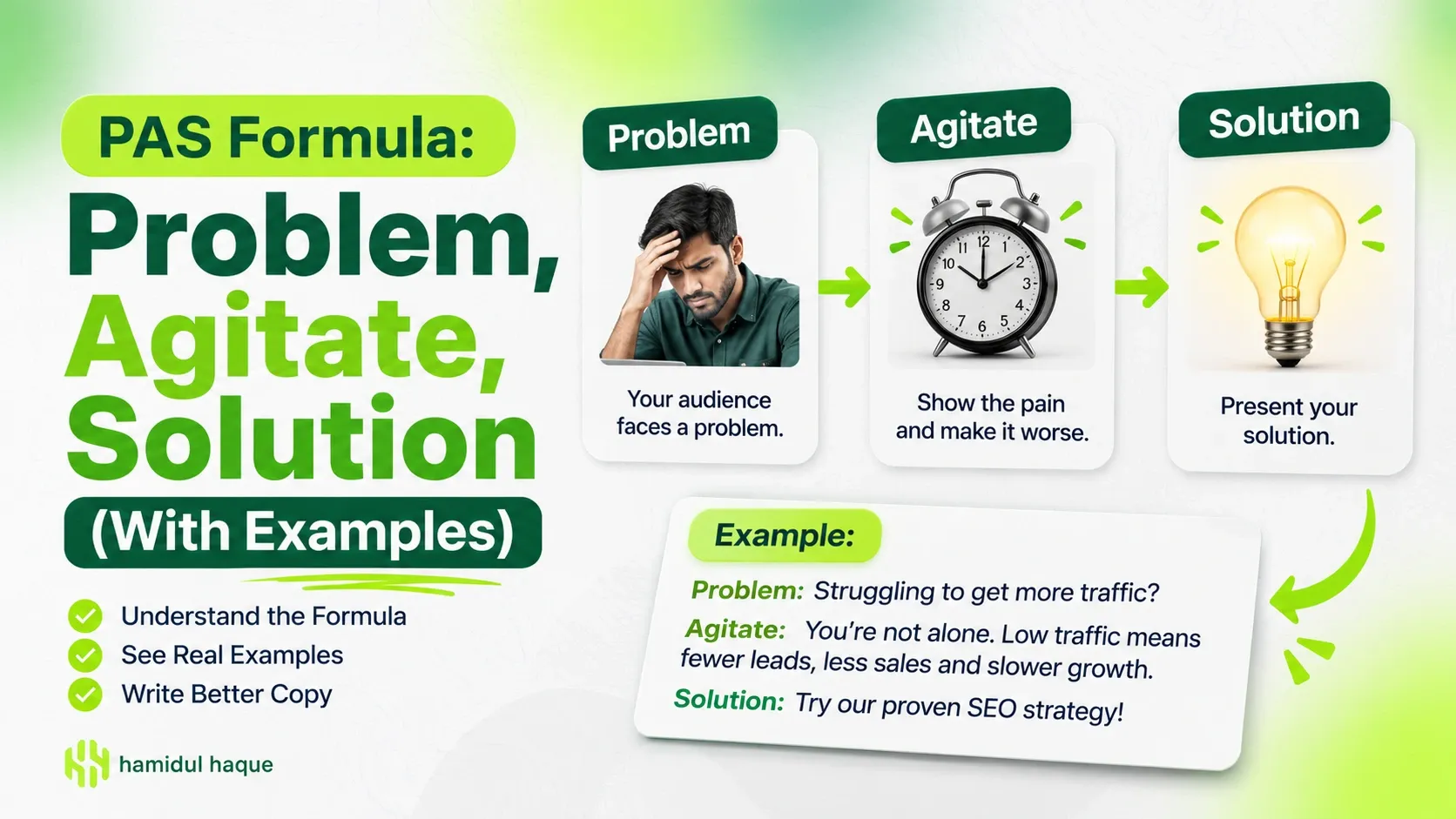
Think of it as the long-form cousin of the PAS formula. PAS stops after Problem, Agitate and Solution. PASTOR keeps going with proof, a detailed offer and a direct call to action, which is why it's popular for sales pages, sales emails and webinar scripts. You'll find it alongside the other structures in my list of copywriting formulas.
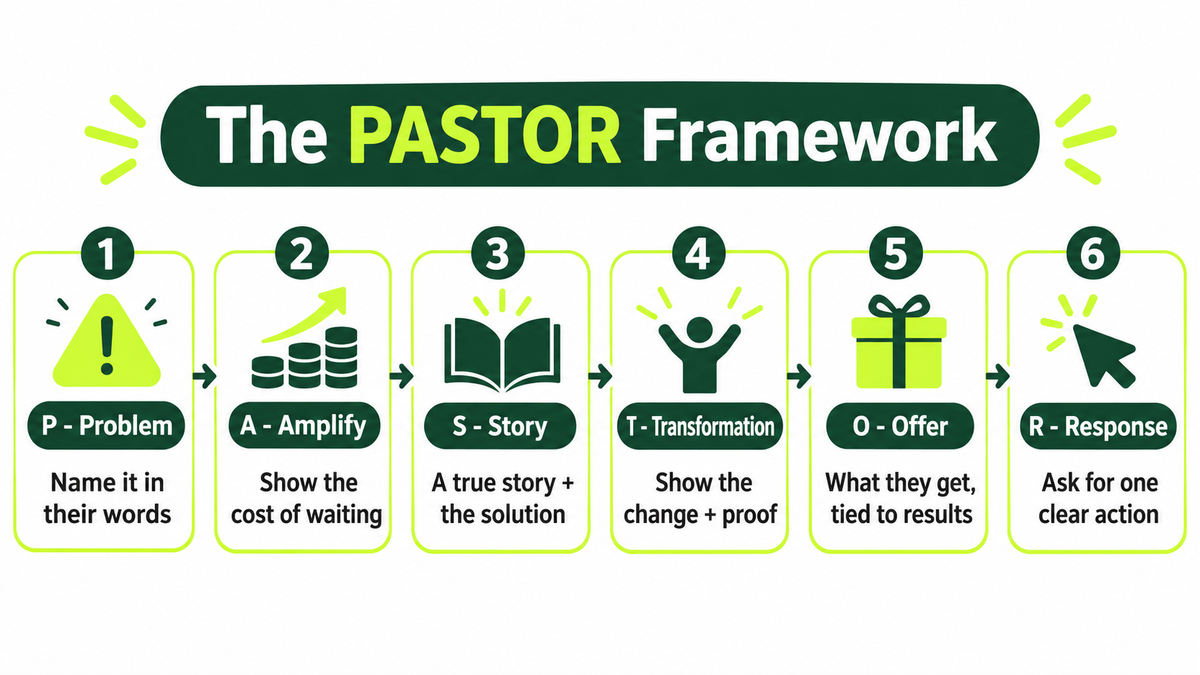
| Letter | Stands for | Its job |
|---|---|---|
| P | Problem | Name the problem in the reader's own words |
| A | Amplify | Show what it costs to leave the problem unsolved |
| S | Story and Solution | Tell a true story that leads to the solution |
| T | Transformation and Testimony | Show the change and prove it with real results |
| O | Offer | Explain what they get, tied back to the transformation |
| R | Response | Ask for one specific action |
Who Created the PASTOR Framework, and Why Is It Called PASTOR?
Ray Edwards described the framework in a guest post on Jeff Goins's blog and later in his book How to Write Copy That Sells. Entrepreneur also covered the six-step model when the book came out.
The name isn't about religion. Edwards explains that the original meaning of "pastor" is a shepherd, someone who cares for and protects a flock. His point is that good sales copy should look after the reader's interests, not just push for a sale. That idea shapes every step: you describe the problem honestly, you only use true stories and you only promise what the product can deliver.
Video: The P.A.S.T.O.R. Framework for Effective Copywriting, a short overview of the six steps and the shepherd idea behind the name.
What Does PASTOR Stand For? The 6 Steps Explained
PASTOR stands for six steps you write in order: Problem, Amplify, Story, Transformation, Offer and Response. Each step below explains what to write and why it matters, with a weak and a strong example.
1. P is for Problem
Start by describing the problem your reader is trying to solve. Edwards' advice is to use the reader's own language, so pull phrases from reviews, support emails, sales calls and comments rather than writing in your own marketing voice. The reader should think, "That's exactly how it feels."
- Weak: "Many freelancers struggle with getting clients."
- Strong: "You check your inbox ten times a day, and it's still just newsletters and invoices you sent last month."
2. A is for Amplify
Next, show what happens if the problem isn't solved. Edwards calls this the most neglected step. It isn't about scaring people. It's about helping the reader see the real cost of doing nothing: lost money, lost time, stress or missed opportunities.
- Weak: "This can hurt your business."
- Strong: "Every month without a steady pipeline means taking whatever work comes along, at whatever rate the client offers."
- Put a number on it: if you earn $5,000 a month and your goal is $15,000, every month you stay stuck costs you $10,000, or $120,000 a year.
Keep it honest. Exaggerating the consequences is where PASTOR copy can tip into manipulation, and readers notice.
3. S is for Story and Solution
Now tell a story about someone who had the same problem and found a way out. That can be you, a client or a customer. The one rule Edwards is firm on: the story must be true. A real story with specific details is far more convincing than an invented success tale, and inventing one damages trust if it's ever discovered.
- Weak: "One day, a freelancer discovered a better way."
- Strong: "Two years ago I had three months of savings left and one client. I stopped pitching on job boards and started sending five short, personal emails a day to agencies I actually wanted to work with."
Introduce your solution at the end of the story, as the thing that made the change possible.
4. T is for Transformation and Testimony
This is the part readers care about most. People don't buy the course modules or the software features. They buy the change: what life or work looks like afterwards. Describe that transformation in concrete terms, then back it up with testimonials, case studies or results from real customers.
- Weak: "Our students get great results."
- Strong: "Within eight weeks, Maya replaced two low-paying clients with one agency retainer. 'I finally plan my month instead of hoping for it,' she says."
Only use real testimonials, with permission. In the US, the FTC's Endorsement Guides say endorsements must reflect honest experiences, and if a testimonial shows unusual results you need to make clear what people can generally expect.
5. O is for Offer
Explain exactly what the reader gets: the product, the bonuses, the support, the guarantee and the price. Edwards' advice is to keep most of your copy focused on the transformation and only a small part on the list of deliverables. When you do list them, tie each one back to the result.
A useful rule of thumb from Edwards: spend about 80% of your copy on the transformation and about 20% on the deliverables. A subheading such as "Here's exactly what you get" makes the offer easy to scan.
The FAB formula is useful here for turning each feature into a benefit.
- Weak: "6 video modules, 12 templates, private community."
- Strong: "6 short video lessons that walk you through building your outreach list, 12 email templates you can send today, and a private group where you can get feedback on your pitches before they go out."
6. R is for Response
Finally, tell the reader exactly what to do next. Edwards points out that this is often the weakest part of sales copy, because writers feel awkward asking for the sale. Don't be shy. Give one clear action, explain what happens after they take it and, where it's honest to do so, give a reason to act now.
- Weak: "Learn more."
- Strong: "Click the button below to join. You'll get instant access to lesson one and the first five templates."
For button wording ideas, see my list of call to action examples.
Video: The Best Copywriting Formula, Using the PASTOR Method to Make More Sales, a walkthrough of all six PASTOR steps.
PASTOR Framework Example: A Full Sales Email
Here's a complete sales email for an invented freelance course, so you can see how the six steps flow together. Swap in your own audience, product and proof.
- Problem: "If you're a freelance designer, you know the feeling: one big project ends and the calendar is suddenly empty."
- Amplify: "So you say yes to rushed jobs at low rates, and there's never time to find better clients. The cycle repeats every few months."
- Story and Solution: "I was stuck in that cycle for three years. What changed it wasn't a new portfolio. It was a simple daily outreach routine: five personal emails to companies I wanted to work with. I turned that routine into a course called Steady Clients."
- Transformation and Testimony: "Students use it to build a pipeline they can rely on. 'I booked two retainer clients in my first six weeks,' says Leo, a brand designer in Lisbon."
- Offer: "Steady Clients includes 6 short lessons, 12 outreach templates and a weekly live Q&A. It's $149, with a 30-day money-back guarantee."
- Response: "Enrolment closes on Friday. Click here to join and start lesson one today."
Notice how little of the email is about the course contents. Most of it is about the reader's situation and the change they want.
How to Use the PASTOR Framework in Other Formats
Sales Pages
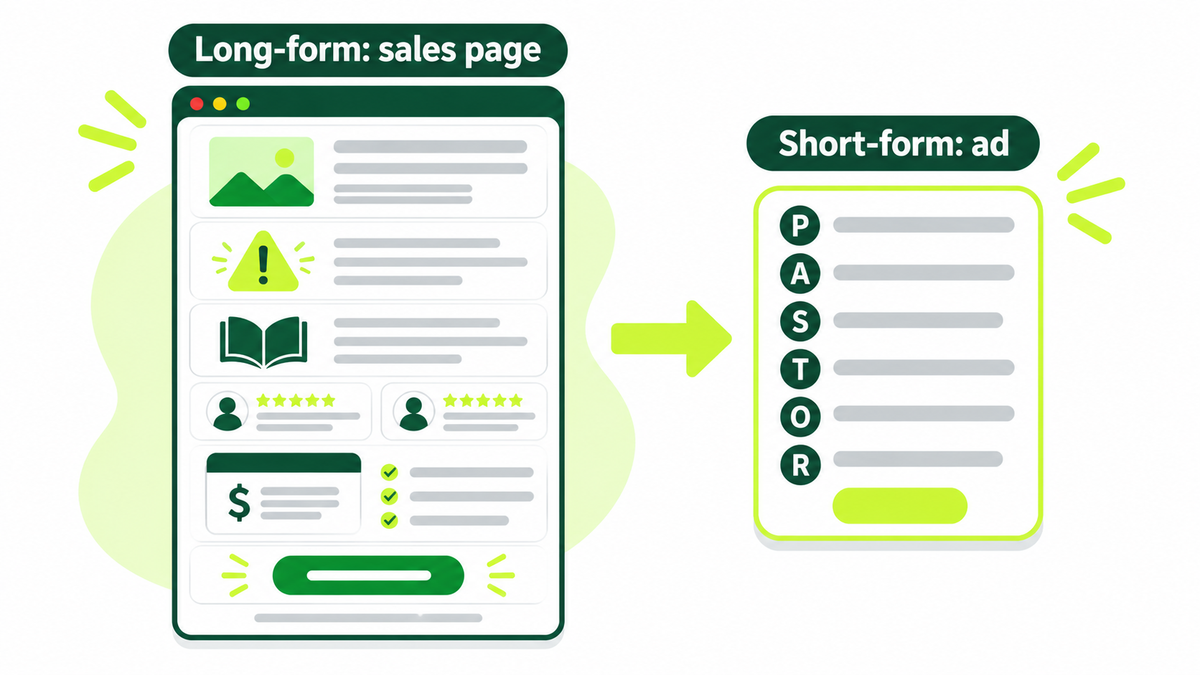
PASTOR maps neatly onto a long-form sales page. Use the Problem and Amplify sections above the fold, the Story in the middle, a testimonials block for Transformation, a pricing section for the Offer and repeated buttons for the Response. My website copywriting guide covers how to lay out the rest of the page.
Webinar and Video Scripts
Spoken formats suit PASTOR well because the Story step feels natural when someone is talking. Spend the first few minutes on Problem and Amplify, tell your story in the middle, show case studies, then present the offer and a single next step at the end.
Video: The Ray Edwards PASTOR Sales Letter Formula, showing how the steps work in a sales letter.
Short Copy (Ads and Social Posts)
You can compress PASTOR into a few lines by giving each step one sentence, but this is where it starts to feel crowded. For very short copy, the BAB formula or PAS is usually a better fit.
Free PASTOR Framework Template
The template gives you a prompt for each step, the example email from this guide and space to draft your own version. Make a copy and reuse it for every sales page, email or script.
Get the Free PASTOR Formula Template
A Google Sheet with a prompt for each PASTOR step, the full example sales email from this guide and space to draft your own. Make a copy and reuse it for every sales page, email or script.
Copy the Template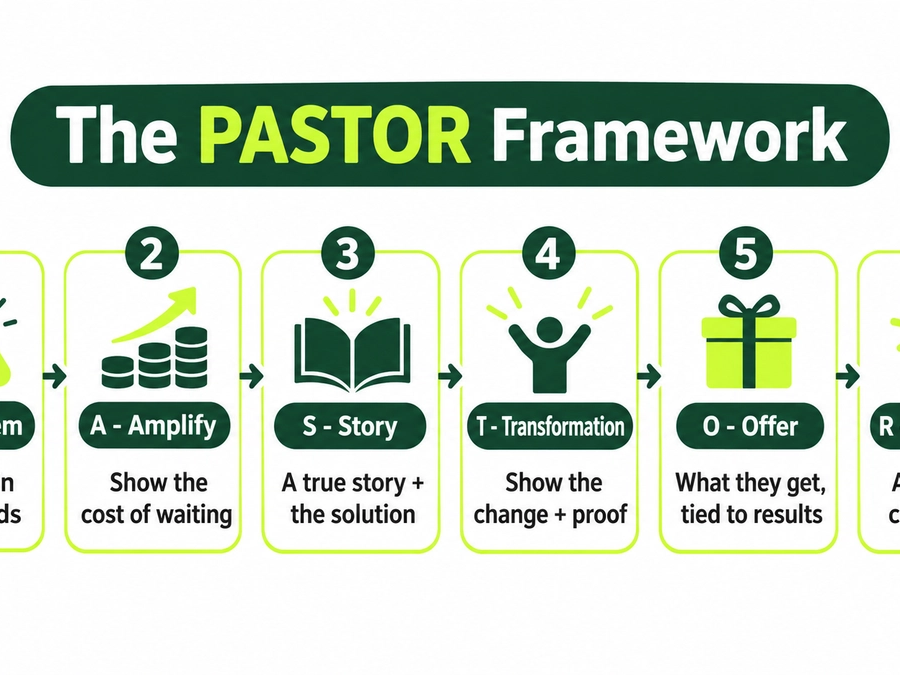
PASTOR vs PAS vs AIDA vs BAB: Which Copywriting Formula Should You Use?
All four formulas lead the reader toward an action, but they suit different lengths and situations.
| Formula | Steps | Best for | Length |
|---|---|---|---|
| PASTOR | Problem, Amplify, Story, Transformation, Offer, Response | Sales pages, sales emails, webinars, high-ticket offers | Long |
| PAS | Problem, Agitate, Solution | Problems readers already feel strongly | Short to medium |
| AIDA | Attention, Interest, Desire, Action | Landing pages and ads that need to build desire | Medium |
| BAB | Before, After, Bridge | Showing a clear transformation in very little space | Short |
Use PASTOR when the buying decision needs trust and detail. Use PAS or BAB when you only have a few lines. Use the AIDA formula when the reader first needs their attention caught before you build interest.
When Should You Use the PASTOR Framework?
PASTOR fits best when:
- You're selling something that needs a considered decision, like a course, programme, service or higher-priced product.
- You have a true story and real customer results to share.
- The reader already knows they have the problem and is weighing up options.
It's a weaker fit for quick, low-cost purchases, for readers who don't yet know they have a problem, and for formats with very little space such as headlines or button text.
Video: Copywriting For Beginners, The PASTOR Copywriting Framework, a longer beginner lesson on using the formula.
Common PASTOR Framework Mistakes
- Over-amplifying. Turning the Amplify step into fear-mongering makes the whole message feel manipulative.
- Making up the story. Edwards insists the story must be true. A composite or invented success tale is a trust problem waiting to happen.
- Skipping the proof. A transformation with no testimonials, numbers or case studies is just a claim.
- Listing features in the Offer. Tie each deliverable back to the result the reader wants.
- A timid Response. "Learn more" or several competing buttons weaken the close. Ask for one action.
- Using PASTOR for everything. Six steps is too much for a tweet or a hero headline. Match the formula to the space.
Before you publish, run your draft through my website copy checklist to catch weak claims and unclear calls to action.
Final Thoughts
The PASTOR framework works because it treats the reader the way a good shepherd treats a flock: with care. Understand their problem, be honest about what it costs, tell a true story, prove the change, make a clear offer and ask for the decision. Copy the free template, outline your next sales email with it and compare the result with what you're using now.
New to the craft? Start with what copywriting is. If you'd rather have an expert write the page for you, take a look at my SEO copywriting service, or get a conversion audit to see what to fix first.


 Hamidul Haque
 Nov 23, 2026