Most copy doesn't fail because the writing is bad. It fails because the reader is asked to act before they're ready. They see a "Buy now" button while they're still wondering whether the page is even for them.
The AIDA formula fixes that by putting the message in the order people actually decide: first they notice, then they care, then they want, then they act. In this guide, I'll explain each stage, show AIDA working on a landing page, an email and an ad, and give you a fill-in template you can use on your next page.
What Is the AIDA Formula (AIDA Model)?
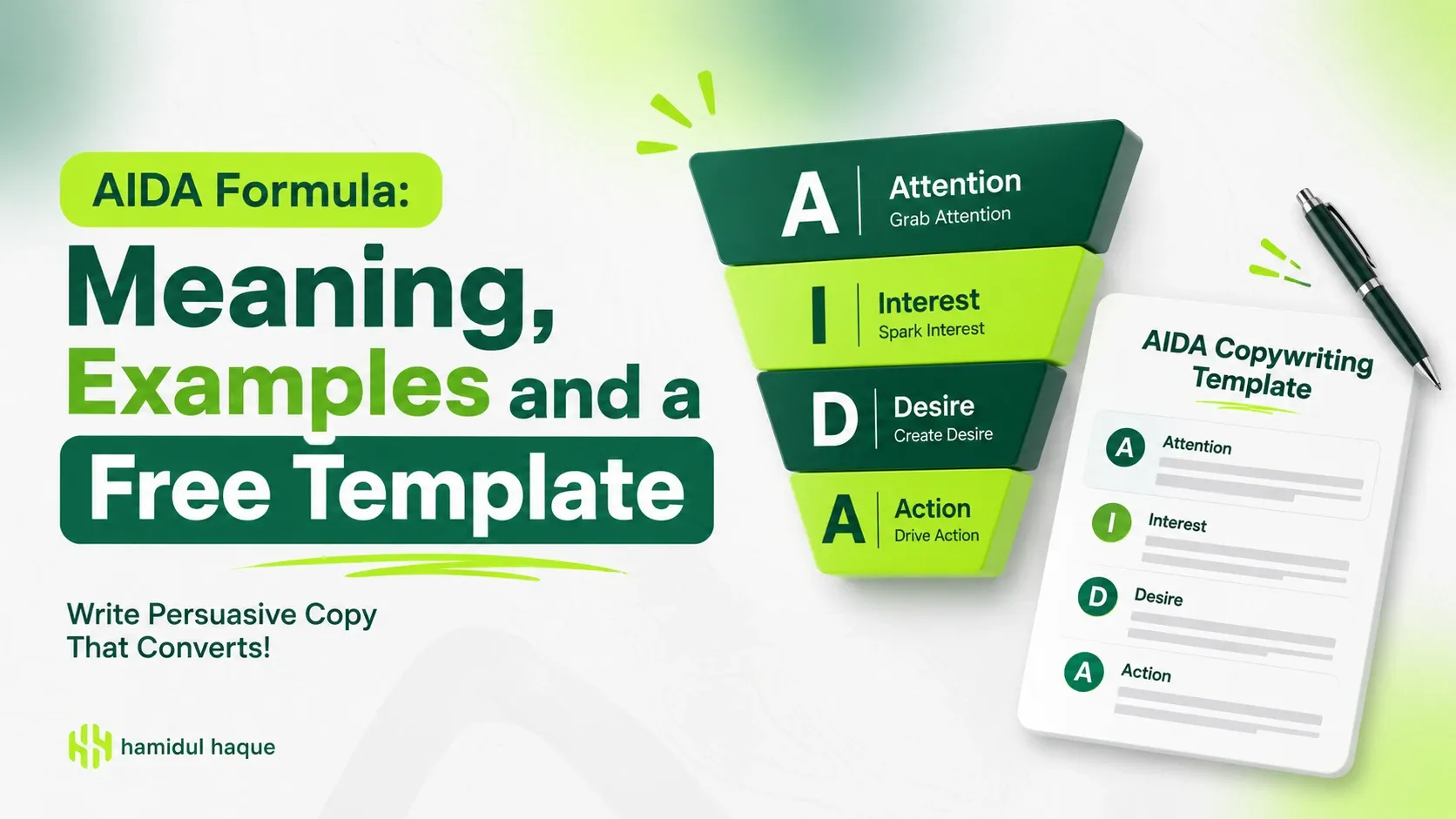
AIDA is a copywriting formula that moves a reader through four stages: Attention, Interest, Desire and Action. Each stage answers one question the reader has, and you only move to the next stage once the current one is answered.
In marketing and sales, the same sequence is usually called the AIDA model. Copywriters call it a formula because they use it to structure a single page, email or ad, while marketers use the model to describe the wider customer journey. The stages are the same either way.
The idea is older than most marketing. American advertiser Elias St. Elmo Lewis began describing these steps around 1898, first for sales calls and later for advertising. Marketer Edward Strong revised and popularised the model in the 1920s (EBSCO). More than a century later, it is still one of the most widely used copywriting formulas, because the way people make decisions hasn't changed much.
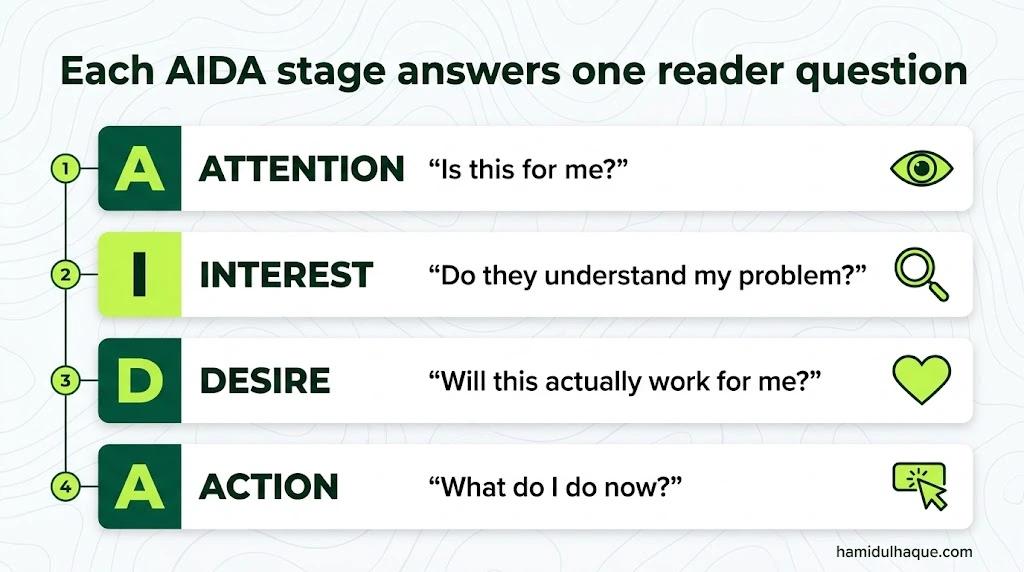
Here is what each stage has to do:
| Stage | The reader's question | Your job | Where it usually appears |
|---|---|---|---|
| Attention | Is this for me? | Make the right reader stop | Headline, subject line, hero section |
| Interest | Do they understand my problem? | Show you know their situation | Intro, problem section |
| Desire | Will this actually work for me? | Prove the result with evidence | Benefits, testimonials, demos |
| Action | What do I do now? | Ask for one clear next step | CTA button, closing line |
The 4 Stages of AIDA, Explained
1. Attention: Earn the First Second
Attention is the headline, the subject line, the first line of an ad or the first screen of a landing page. Its only job is to make the right reader stop and think, "This is about me."
That first screen carries most of the weight. In a 2018 eyetracking study, Nielsen Norman Group found that people spent about 57% of their page-viewing time above the fold, and 74% within the first two screens.
That last part matters. Attention is not about being loud or clever. A shocking headline that attracts the wrong people is worse than a plain one that attracts the right ones. On a website, attention lives in the hero section, so that is where most of your effort should go.
Ways to earn attention:
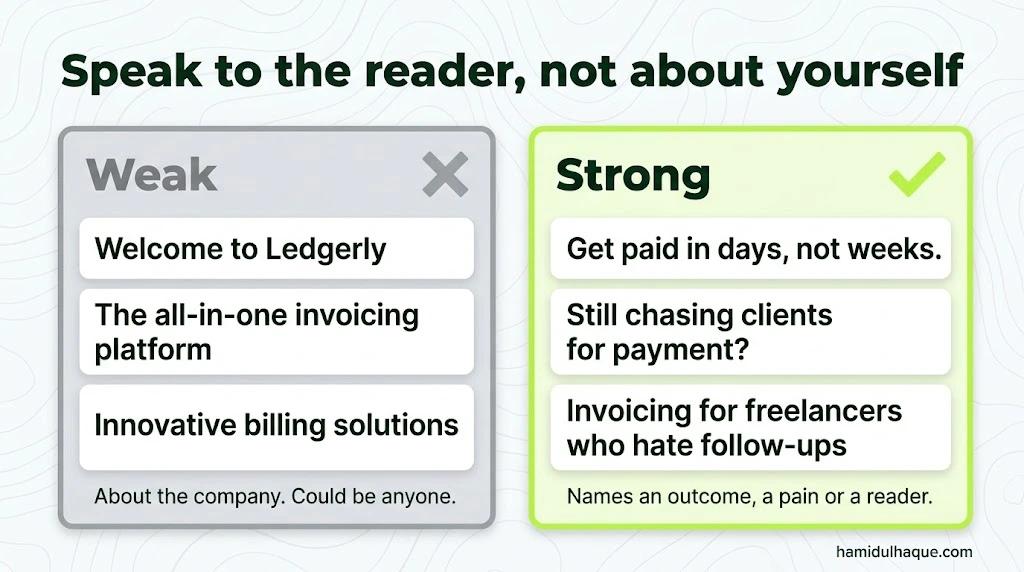
- Name the reader or their situation: "For freelancers who send more than five invoices a month."
- Lead with the outcome: "Get paid in days, not weeks."
- Point at a specific pain: "Still chasing clients for payment?"
- Use a surprising, true number: only if you can back it up.
2. Interest: Make It About Them
Once you have attention, you have a few seconds to prove the page is worth reading. Interest comes from relevance, not from describing your company. The reader is asking, "Does this understand my problem?"
Build interest by describing the reader's situation more precisely than they would themselves. Show that you know what their week looks like, what they've tried and why it didn't work. Short paragraphs, a clear subheading and one strong detail do more here than a list of features.
Keep it tight. Nielsen Norman Group estimates that visitors read about 20% of the words on an average web page, and at most 28%. Every sentence in the interest stage has to earn its place.
A useful test: if you could swap your company name for a competitor's and the paragraph still works, it isn't building interest yet.
3. Desire: Show Proof, Not Adjectives
Desire is where most AIDA copy breaks. The writer moves from "here's an interesting problem" straight to "click here," and the reader isn't convinced yet. Desire is the stage where the reader starts to picture the result and believes it can happen for them.
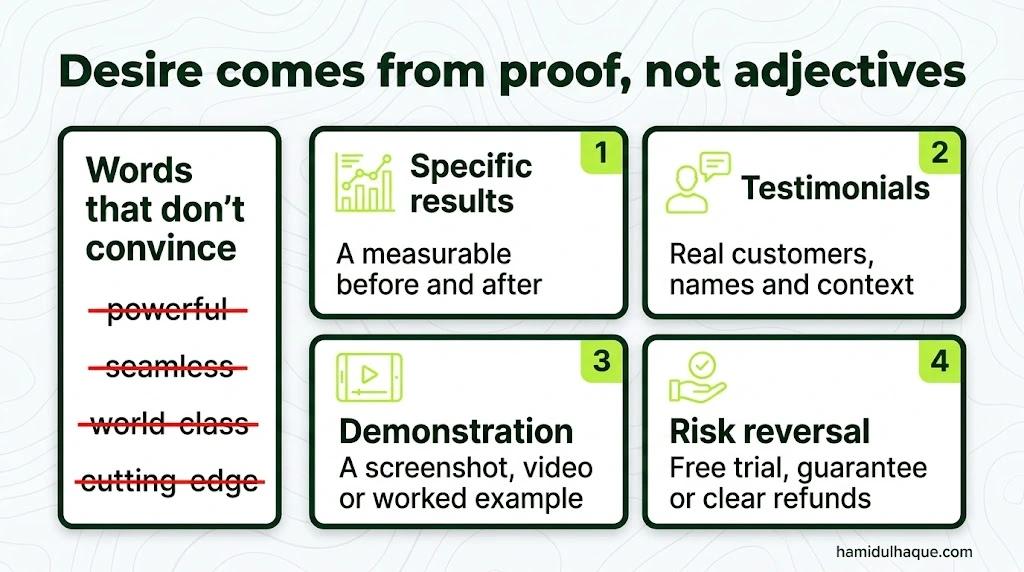
Adjectives like "powerful," "seamless" and "world-class" don't create desire. Evidence does. Turn features into benefits, then back the benefits with proof:
- Specific results: a measurable before and after.
- Testimonials: real customers, with names and context.
- Demonstration: a screenshot, a short video, or a worked example.
- Risk reversal: a free trial, a guarantee or a clear refund policy.
Reviews are one of the strongest forms of proof you can add. Research from Northwestern University's Spiegel Research Center found that a product with five reviews was 270% more likely to be purchased than a product with none.
If you only have time to improve one stage of an existing page, improve this one.
4. Action: Ask for One Clear Next Step
The action stage tells the reader exactly what to do and what happens next. One page, one primary action. Two competing buttons ("Book a demo" and "Start free trial" given equal weight) split the reader's attention right when it should be focused.
Good calls to action are:
- Specific: "Send your first invoice free" beats "Get started."
- Low-friction: say what it costs in time or money, especially if the answer is "nothing."
- Reassuring: a short line under the button ("No credit card needed") answers the last doubt.
Need ideas for the button itself? My list of call to action examples has 25 options grouped by goal.
6 AIDA Formula Examples
The examples below use a fictional product, Ledgerly, an invoicing app for freelancers. Using one offer across channels makes it easier to see how AIDA stays the same while the format changes.
AIDA Landing Page Example
On a landing page, AIDA maps onto the sections from top to bottom. The hero carries attention, the problem section builds interest, features and testimonials create desire, and the final call to action closes.
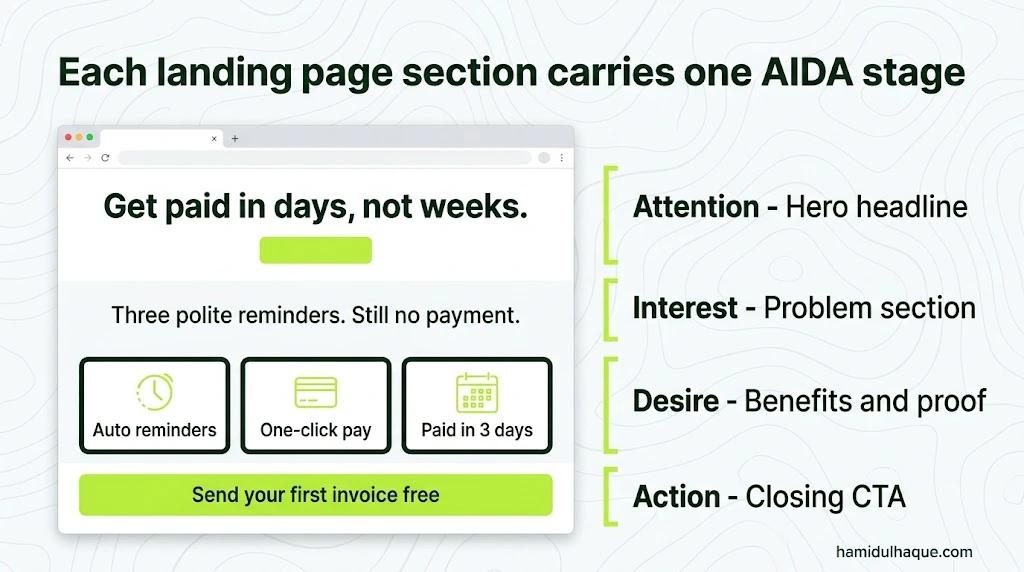
- Attention (hero headline): "Get paid in days, not weeks."
- Interest (problem section): "You finished the project two months ago. You've sent three polite reminders. The money still isn't in your account."
- Desire (benefits and proof): "Ledgerly sends automatic reminders, accepts card payments in one click and shows you exactly who owes what, so you get paid without writing a single follow-up email."
- Action (closing CTA): "Send your first invoice free" with "No credit card needed" underneath.
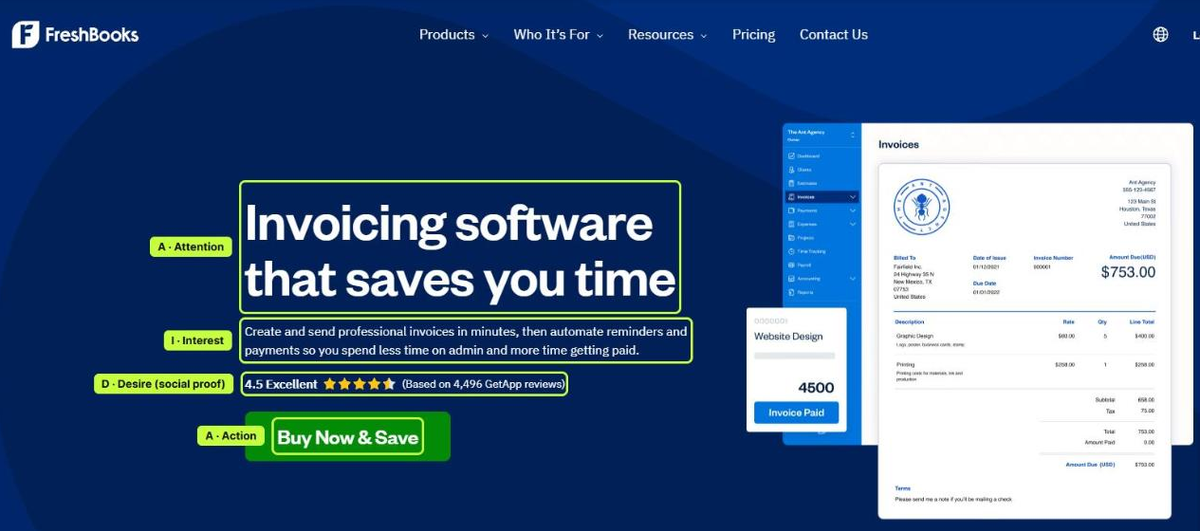
Real-world example: FreshBooks runs all four stages in the hero section of its invoicing page. The headline grabs attention, the subheading builds interest, the GetApp rating adds desire, and the button asks for one action.
If you're planning a full page, my guide to website copywriting covers how to write each of these sections in more depth.
AIDA Email Example
In email, the subject line does the attention work, and the body runs through interest, desire and action in a few short paragraphs.
Subject: The invoice you sent in March
Hi Sam, if you're like most freelancers, at least one client is late right now. You don't want to chase them, and you don't want to lose the client either.
Ledgerly sends polite, automatic reminders for you, so you never have to write the awkward email. Clients can pay by card in one click, straight from the invoice.
Try it on your next invoice. It's free for your first three clients.
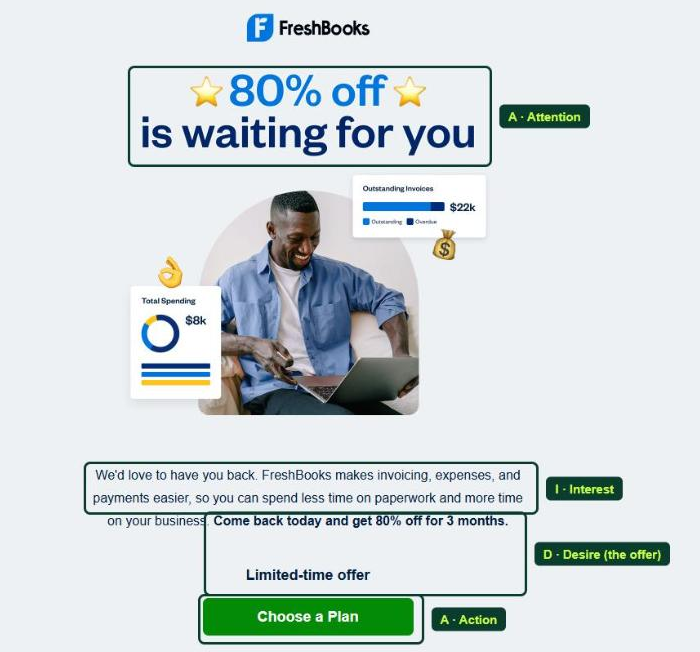
Real-world example: This FreshBooks win-back email follows the same order. The "80% off is waiting for you" headline earns attention, the first paragraph restates the benefit, the limited-time offer adds desire, and "Choose a Plan" is the one main action.
AIDA Ad Example
An ad compresses everything into a few lines, so each stage might be a single sentence.
Attention: Still waiting on that invoice?
Interest: Late payments make freelance income impossible to plan.
Desire: Ledgerly reminds clients for you and lets them pay in one click.
Action: Send your first invoice free.
Here is the same offer side by side:
| Stage | Landing page | Ad | |
|---|---|---|---|
| Attention | Get paid in days, not weeks. | Subject: The invoice you sent in March | Still waiting on that invoice? |
| Interest | Three polite reminders, still no payment. | At least one client is late right now. | Late payments make income impossible to plan. |
| Desire | Automatic reminders, one-click card payments, a clear view of who owes what. | Ledgerly sends the reminders for you, and clients pay from the invoice. | Reminds clients for you, one-click payment. |
| Action | Send your first invoice free | Try it on your next invoice | Send your first invoice free |
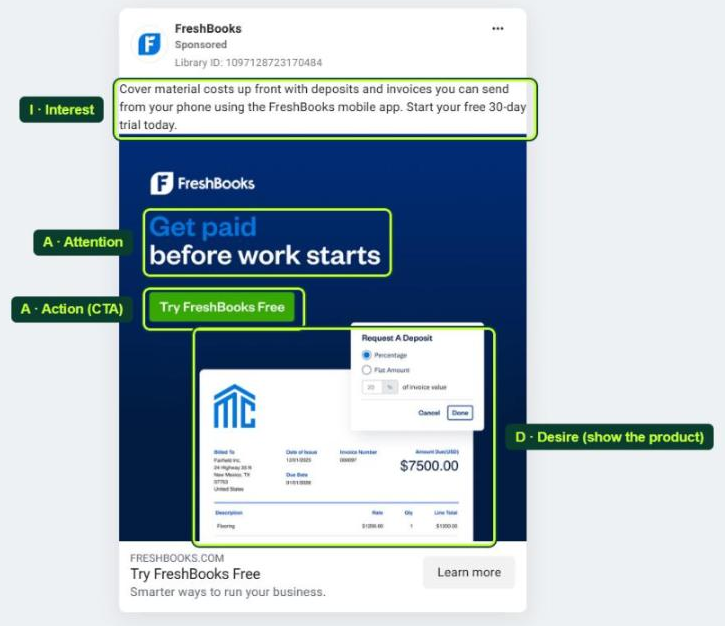
Real-world example: This live FreshBooks ad from Meta's Ad Library uses AIDA in a paid social ad. The headline in the image promises an outcome, the primary text speaks to a specific situation, the product screenshot builds desire, and "Try FreshBooks Free" gives one next step.
AIDA Social Media Post Example
On social media, the first line has to stop the scroll, so attention and interest often share the opening sentences.
Attention: Freelancers, how many unpaid invoices are sitting in your inbox right now?
Interest: Most clients aren't ignoring you. Your reminder just got buried under everything else.
Desire: Ledgerly follows up for you and lets clients pay in one click, so you never write another awkward chase email.
Action: Try it free on your next invoice. Link in the comments.
AIDA Video Script Example
In a short video, AIDA maps onto time instead of sections. A 45-second product video might run like this:
- 0–3 seconds (Attention): an inbox full of "Payment overdue" emails and the line "Still chasing invoices?"
- 4–15 seconds (Interest): a freelancer explaining how late payments make it impossible to plan the month.
- 16–40 seconds (Desire): a screen recording of an automatic reminder going out and a client paying by card.
- Last 5 seconds (Action): "Send your first invoice free" on screen, with the link in the description.
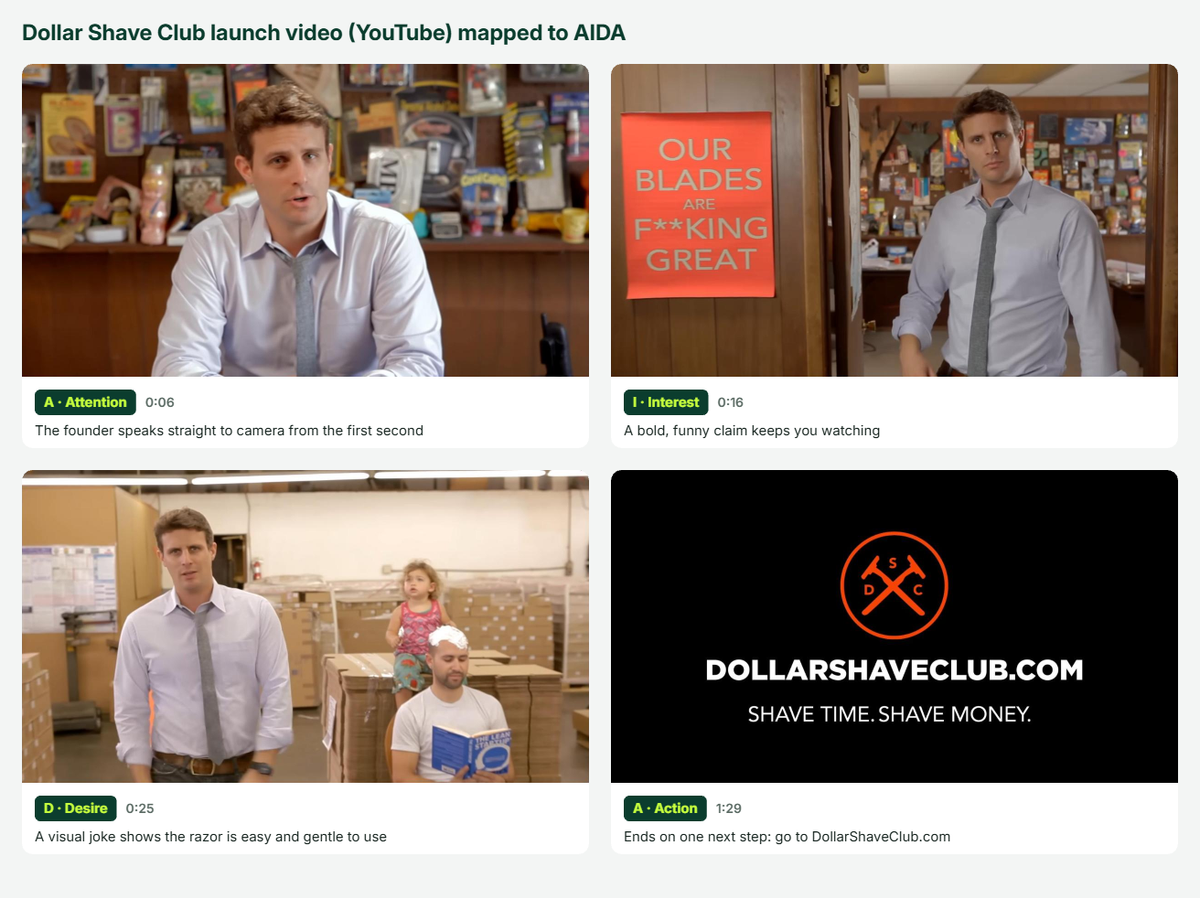
Real-world example: Dollar Shave Club's 2012 launch video is a widely cited AIDA example. It opens with the founder talking straight to camera, holds interest with a bold claim, shows the product in a funny scene, and ends on one action: visit the website.
AIDA Product Page Example
A product or pricing page uses the same order, but desire carries more weight because visitors are comparing options:
- Attention: a headline that names the outcome, such as "Invoicing that chases payments for you."
- Interest: who it's for, such as "Built for freelancers who send 5 to 50 invoices a month."
- Desire: features written as benefits, a product screenshot and reviews from real customers.
- Action: one clear button, such as "Start free," with "No credit card needed" underneath.
Need Copy That Moves Readers to Act?
I write and structure landing pages, emails and website copy around how your readers actually decide, from the first headline to the final click.
Get in Touch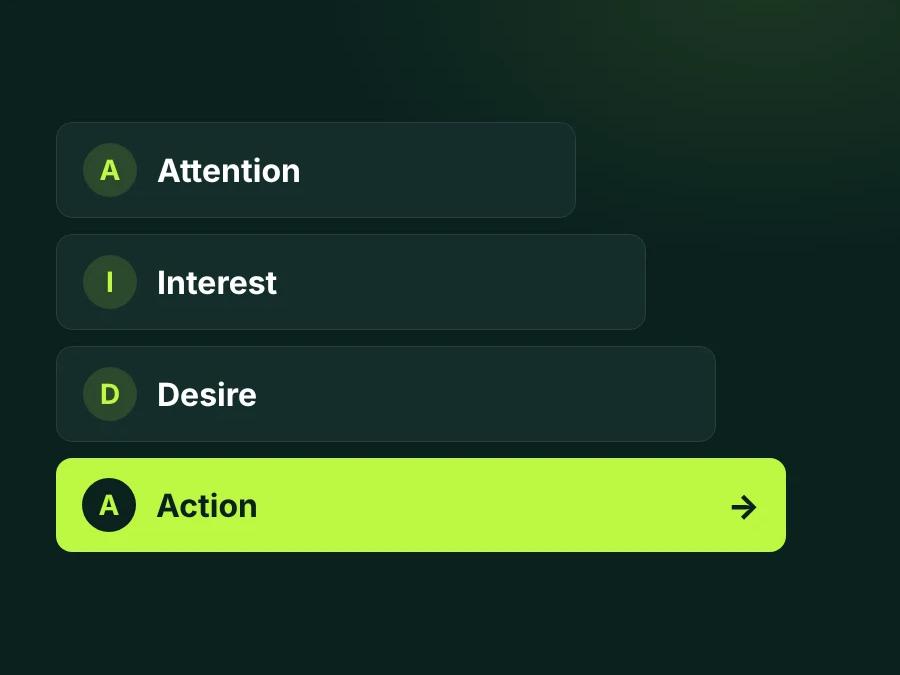
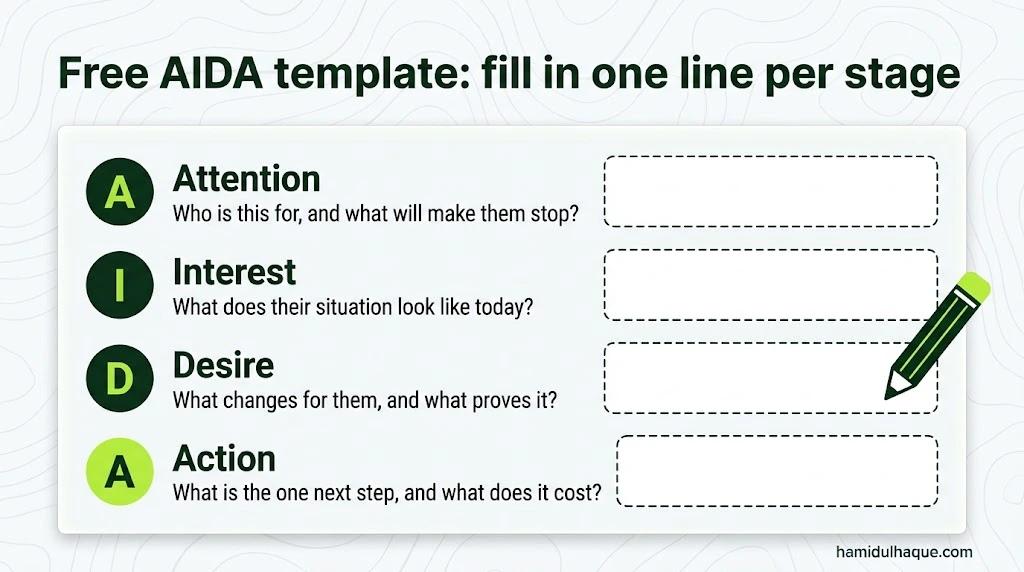
Free AIDA Template (Copy and Fill In)
Use this template before you write the full piece. Write one or two sentences for each stage. If you can't fill in a row, that's the part of your message that needs more thinking, not more words.
| Stage | Prompt to answer | Your copy |
|---|---|---|
| Attention | Who is this for, and what outcome or pain will make them stop? | ... |
| Interest | What does their situation look like today, in their words? | ... |
| Desire | What changes for them, and what proof shows it will? | ... |
| Action | What is the one next step, and what does it cost them? | ... |
Get the Free AIDA Template
A fill-in Google Doc with prompts for each stage, a worked example and a final checklist. Make your own copy and use it on your next page, email or ad.
Make a Free Copy
When to Use AIDA (and When Not To)
AIDA works best when the reader doesn't know you yet and you're asking for one clear action. That makes it a strong fit for:
- Landing pages for a single offer
- Cold emails and outreach
- Ads and social posts
- Product launches and announcement pages
- Sales pages for a product with a clear benefit
It's a weaker fit when the reader already knows they have a painful problem and is comparing solutions. In that case, the Problem, Agitate, Solution (PAS) formula often works better, because it starts with the pain instead of spending time earning attention. It's also not the right structure for in-depth guides or documentation, where the reader came to learn, not to be persuaded.
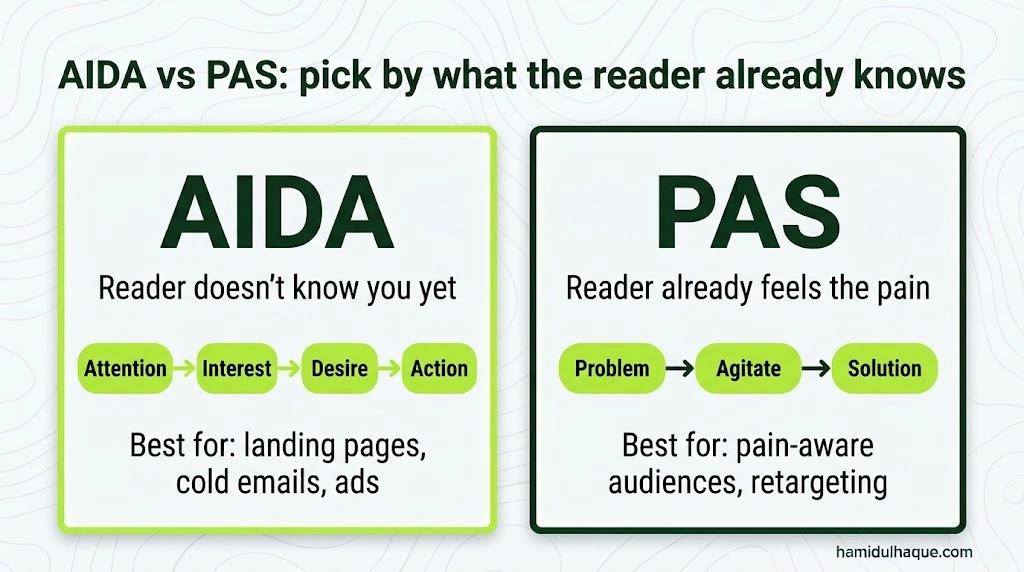
AIDA and PAS aren't rivals. Many good pages use AIDA for the overall structure and PAS inside the interest section. My breakdown of 20+ copywriting formulas compares the most useful options and when to pick each one.
AIDA and the Marketing Funnel
The AIDA model also maps neatly onto the marketing funnel. Each stage matches a point in the buyer's journey, which helps you decide what kind of content each piece should be.
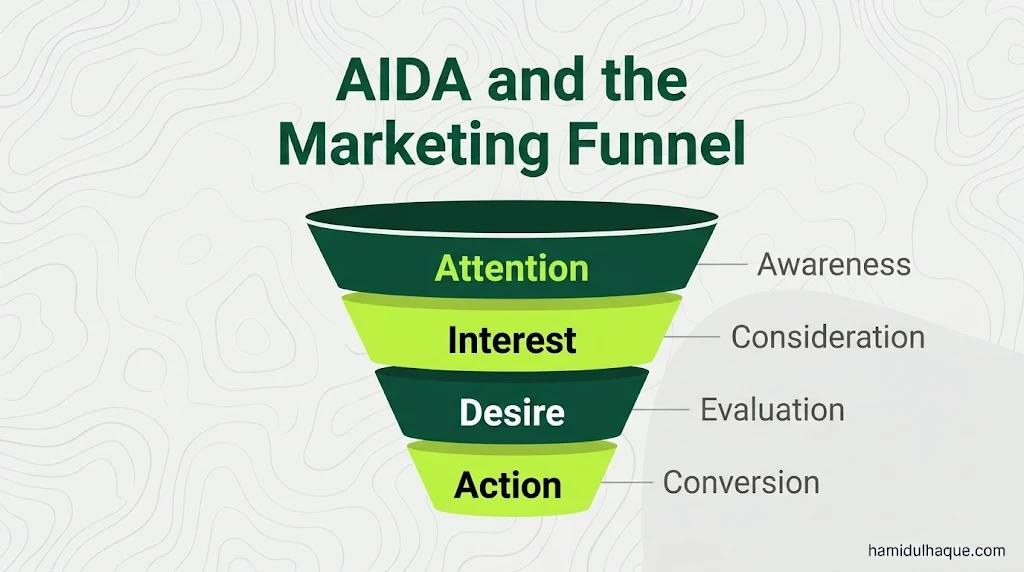
| AIDA stage | Funnel stage | Typical content |
|---|---|---|
| Attention | Awareness (top of funnel) | Ads, social posts, search snippets, headlines |
| Interest | Consideration (middle) | Blog posts, guides, problem-focused landing pages |
| Desire | Evaluation (middle to bottom) | Case studies, demos, reviews, comparison pages |
| Action | Conversion (bottom) | Pricing pages, sign-up forms, sales emails |
AIDA vs PAS vs BAB
AIDA is one of several classic structures. Here is how it compares with two other popular formulas. For the full list, see my guide to copywriting formulas.
| Formula | Starts with | Best for |
|---|---|---|
| AIDA (Attention, Interest, Desire, Action) | Earning attention | Readers who don't know you yet; landing pages, ads, cold emails |
| PAS (Problem, Agitate, Solution) | A pain the reader already feels | Problem-aware readers; short sales copy and emails |
| BAB (Before, After, Bridge) | The reader's current situation | Showing a transformation; social posts and case studies |
5 Common AIDA Mistakes
- Skipping desire. Going from an interesting problem straight to "Buy now" is the most common mistake. Add proof before the ask.
- Writing attention for everyone. A clever headline that attracts the wrong readers lowers conversions. Aim it at the person you can actually help.
- Talking about yourself in the interest stage. Your company history doesn't build interest. The reader's situation does.
- Asking for more than one action. Two equal buttons create hesitation. Pick the primary action and make everything else secondary.
- Treating AIDA as a strict sequence of paragraphs. It's a sequence of reader questions, not a rule that every stage gets one paragraph. On a short ad, attention and interest can share a sentence.
Limitations of the AIDA Model
AIDA is a useful structure, not a law of how people buy. Keep these limits in mind:
- It's linear. Real buyers jump between stages, leave, compare options and come back days later.
- It stops at the purchase. It says nothing about onboarding, satisfaction or repeat business, which is why variations like AIDAS and AIDAR exist.
- It assumes one decision-maker. In B2B sales, several people often need to be convinced, each with different questions.
- It gives you the order, not the words. You still need research into what your readers care about to fill each stage well.
AIDA Variations: AIDCA, AIDAS and AIDAR
Several variations add a stage to the original four:
- AIDCA adds Conviction between desire and action. It's useful for expensive or risky purchases, where the reader needs extra proof, such as guarantees, case studies or certifications, before acting.
- AIDAS adds Satisfaction after action, a reminder that the experience after the purchase shapes whether the customer comes back.
- AIDAR adds Retention, which focuses on keeping customers engaged and turning them into repeat buyers and advocates (Siege Media).
Here is what the extra Conviction stage of AIDCA could look like for the Ledgerly example, placed just before the call to action:
Conviction: Used by 3,000 freelancers. If you don't get paid faster within 30 days, we'll refund your first month.
For most pages and emails, the original four stages are enough. Reach for AIDCA when trust is the main obstacle.
Final Thoughts
AIDA is simple, and that's its strength. Before you write anything, ask four questions: Will the right reader notice this? Will they feel it's about them? Will they believe it works? Do they know exactly what to do next?
If you can answer yes to all four, the copy will usually work, even if it isn't polished. If you'd rather have someone write and structure the page for you, take a look at my SEO copywriting service.


 Hamidul Haque
 Nov 23, 2026