Whenever I write content that I want to rank in search engines, I don't start by adding keywords and I start by understanding what readers are actually looking for. Modern SEO copywriting is about creating content that answers real questions, demonstrates expertise, and provides genuine value. Search engines have become much better at understanding context, entities, and search intent, which means quality now matters far more than keyword repetition.
This shift is reflected in industry data. According to BrightEdge Research, 68% of all trackable website traffic comes from organic and paid search, highlighting the critical role search visibility plays in attracting visitors and growing a website. Because of this, I follow a structured copywriting checklist every time I publish content. It helps me optimise everything from search intent and semantic relevance to readability, internal linking, metadata, and E-E-A-T signals.
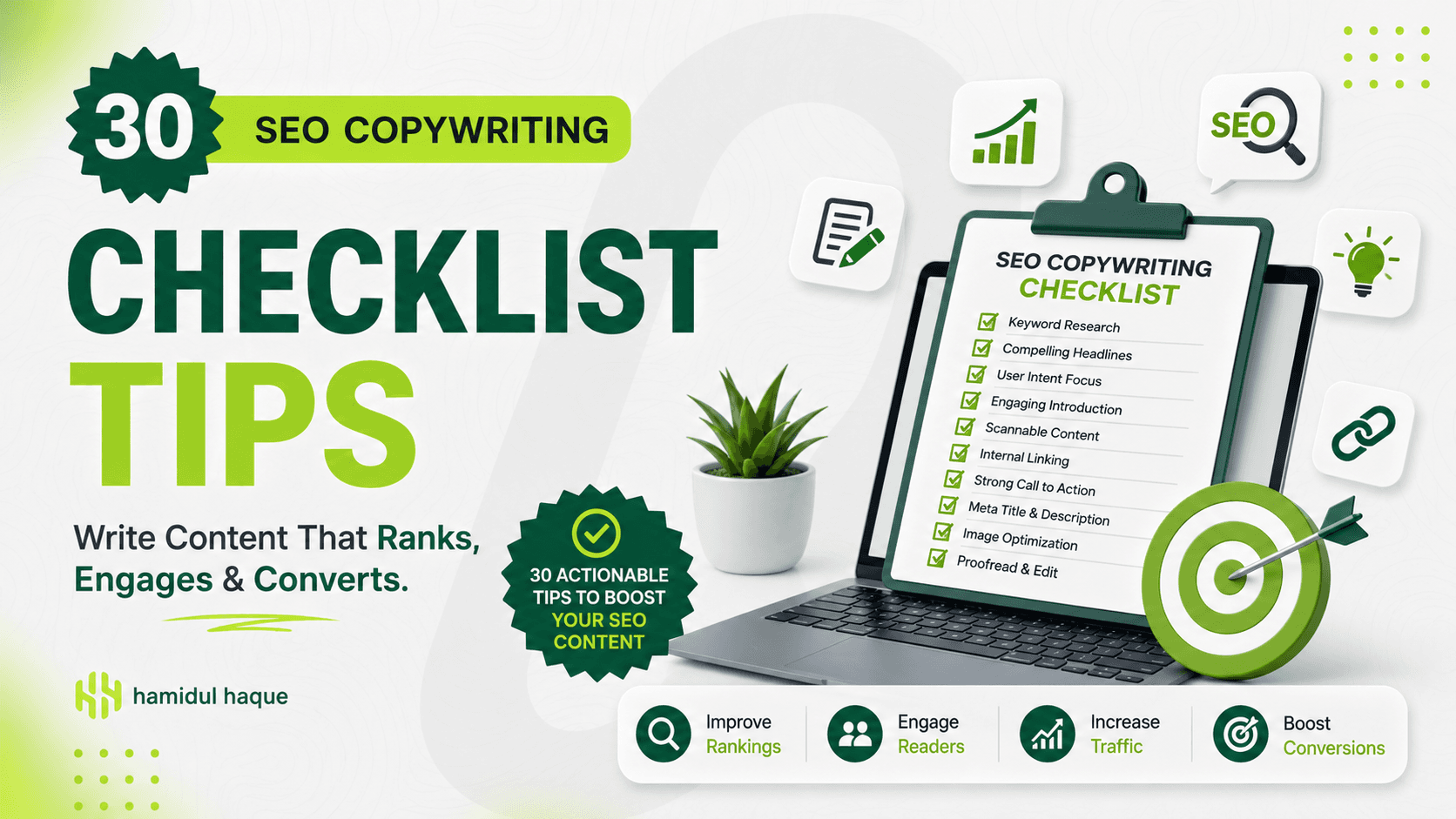
In this guide, I'll walk you through 30 practical SEO copywriting checklist tips that I personally use to create search-friendly content that ranks higher and delivers lasting value.
Get Your Copywriting SEO Checklist To Stay Updated
Continuous Optimization is the key in SEO copywriting. Check this list while you are optimizing your copy.
Download Checklist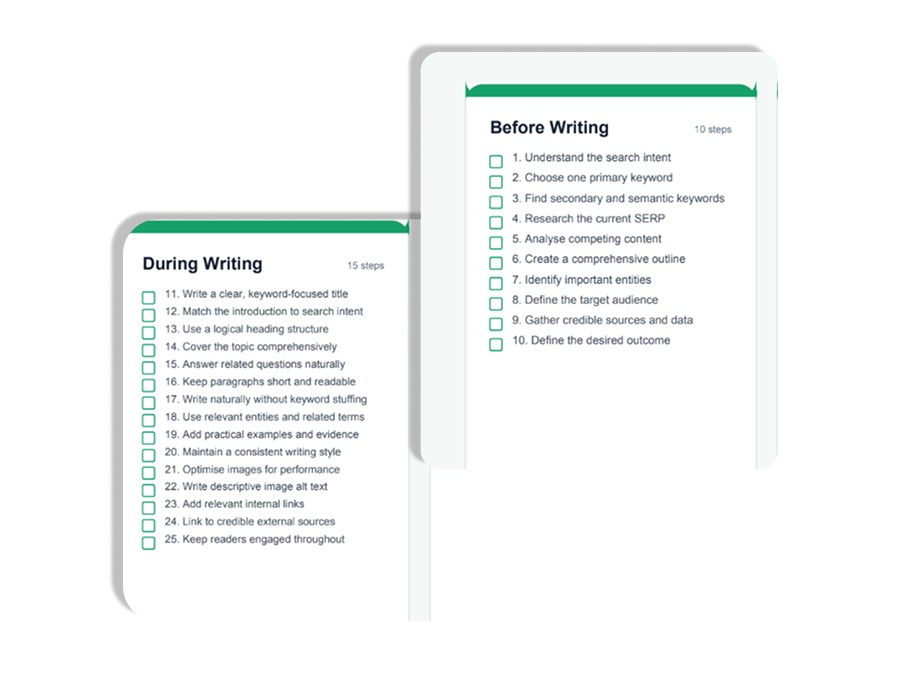
What Is SEO Copywriting?
SEO copywriting is the practice of writing content that helps both readers and search engines. My goal is not simply to include keywords in an article. Instead, I create content that answers a user's question, satisfies search intent, and provides enough context for search engines to understand the topic. Effective SEO copywriting combines high-quality writing with keyword research, semantic optimisation, logical structure, and user-focused content.
Over the years, SEO copywriting has evolved significantly. Search engines now evaluate content based on relevance, expertise, originality, and user satisfaction rather than keyword frequency alone. According to Google's guidance on creating helpful content, publishers should focus on producing people-first content that demonstrates experience and provides genuine value. This approach aligns with modern ranking systems that reward useful, trustworthy, and well-organised content.
SEO Copywriting vs. Content Writing
SEO copywriting and content writing are closely related, but they serve different purposes. Content writing mainly focuses on educating, informing, or engaging readers. SEO copywriting combines useful content with search optimization and conversion-focused messaging.
I explain the full keyword research, content structure, and on-page optimisation process in my SEO for copywriters guide.
| Area | Content Writing | SEO Copywriting |
|---|---|---|
| Primary goal | Educate, inform, or entertain readers | Generate organic traffic and encourage action |
| Search intent | May cover a broad topic | Targets a specific search intent |
| Keyword use | Keywords are optional | Uses primary and related keywords naturally |
| Structure | Focuses mainly on readability | Uses optimised headings, entities, links, and metadata |
| Conversion focus | Usually provides information | Encourages enquiries, sign-ups, clicks, or purchases |
| Common formats | Guides, reports, articles, and case studies | SEO articles, landing pages, service pages, and product pages |
| Performance metrics | Engagement and readership | Rankings, clicks, organic traffic, and conversions |
SEO Copywriting vs. Traditional Copywriting
Traditional copywriting focuses on persuading readers to take a specific action, such as purchasing a product, requesting a quote, or signing up for a service. SEO copywriting uses the same persuasive principles but also helps the content appear for relevant searches.
| Area | Traditional Copywriting | SEO Copywriting |
|---|---|---|
| Primary goal | Generate conversions | Generate organic traffic and conversions |
| Audience source | Ads, email, social media, or direct visits | Search engines and other marketing channels |
| Keyword research | Usually not required | Uses primary and related keywords |
| Search intent | Not always considered | Matches a specific search intent |
| Content structure | Focuses on persuasion | Balances readability, SEO, and persuasion |
| Common formats | Ads, emails, brochures, and sales letters | SEO articles, landing pages, product pages, and service pages |
| Performance metrics | Leads, sales, and conversion rate | Rankings, traffic, leads, and conversion rate |
I use traditional copywriting when the audience has already reached the offer. I use SEO copywriting when I first need to attract people through search and then guide them toward a specific action.
To structure persuasive headlines, benefits, and calls to action, I often use proven copywriting formulas such as AIDA, PAS, and BAB.
Why SEO Copywriting Matters
Publishing great content is no longer enough if your audience cannot discover it. SEO copywriting increases the likelihood that your pages appear for relevant searches, attract qualified visitors, and answer users' questions more effectively than competing content. It also supports long-term organic growth by helping search engines understand your expertise and topical authority. When done correctly, SEO copywriting benefits readers, improves search rankings, and contributes to sustainable business growth.
How Modern Search Engines Evaluate Content
Search engines have become much more sophisticated than they were a decade ago. Instead of relying on exact-match keywords, they analyse the overall meaning of a page, how well it answers a query, and whether users find the content helpful. This means that writing naturally and covering a topic comprehensively is often more valuable than repeating the same keyword multiple times.
When I create SEO content, I think about how search engines interpret information rather than how often a keyword appears. Modern algorithms evaluate search intent, semantic relationships, topical depth, E-E-A-T signals, page quality, and user experience to determine whether a page deserves to rank. Understanding these factors allows me to produce content that satisfies both readers and search engines.
Understanding Search Intent
Every search begins with a purpose. Someone searching for "SEO copywriting checklist" expects actionable advice, not a definition alone. Before writing, I identify whether the query is informational, commercial, navigational, or transactional. Matching the content to the user's intent helps improve relevance and increases the likelihood of ranking.
Semantic SEO and Entity-Based Optimisation
Search engines now understand topics through entities and the relationships between them. Rather than relying only on exact keywords, they analyse related concepts that help define a subject. For example, an article about SEO copywriting naturally connects with entities such as search intent, keyword research, topical authority, metadata, internal linking, E-E-A-T, readability, and user experience. Including these related concepts helps search engines understand the page more accurately.
The Role of E-E-A-T
Google uses the concept of Experience, Expertise, Authoritativeness, and Trustworthiness, commonly known as E-E-A-T, to evaluate content quality. While E-E-A-T is not a direct ranking factor, it influences how Google's quality systems assess whether content is reliable and helpful. I strengthen E-E-A-T by using credible sources, providing accurate information, sharing practical experience where appropriate, and keeping content updated.
Helpful Content and Information Gain
Publishing content that repeats what already exists rarely creates a competitive advantage. I focus on adding original insights, practical examples, updated information, and actionable advice that improves the reader's understanding of the topic. This concept is often referred to as information gain, where each article contributes something genuinely useful instead of duplicating existing search results.
Why Topical Authority Matters
Topical authority is built by covering a subject comprehensively rather than publishing isolated articles. Instead of creating one page about SEO copywriting, I also write supporting content on keyword research, search intent, semantic SEO, on-page optimisation, internal linking, content strategy, and related topics. This interconnected content helps search engines recognise expertise while giving readers a more complete learning experience.
My Complete SEO Copywriting Checklist
Now that we've covered the fundamentals of SEO copywriting and how search engines evaluate content, it's time to move into the practical checklist. This section contains 30 actionable tips that I personally follow whenever I create search-friendly content. I've organised the checklist into logical stages so you can optimise your content before writing, during the writing process, and before publishing. By following these steps consistently, you'll build a repeatable workflow that improves content quality, strengthens topical authority, and increases your chances of earning sustainable organic traffic.
Before You Start Writing
Writing an SEO-friendly article begins long before the first sentence. The preparation stage determines whether your content will satisfy user intent, cover the topic comprehensively, and compete with existing search results. I spend a significant amount of time researching before I start writing because a well-planned article is much easier to optimise than one created without a strategy.
The first ten tips in this checklist focus on planning. They help me identify the right keyword, understand what users expect, analyse competing pages, and build an outline that covers every important subtopic. Skipping these steps often leads to thin content, poor rankings, and missed opportunities.
1. Understand the Search Intent
Search intent is the reason behind a user's query. Before writing any content, I ask myself a simple question: What does the reader expect to find after searching this keyword?
Most search queries fall into one of four categories:
- Informational
- Navigational
- Commercial
- Transactional
For a keyword like "SEO copywriting checklist," the intent is clearly informational. Readers want a practical checklist that they can follow to improve their content. They are not looking for a service page or a sales pitch.
When I understand search intent correctly, I can create content that matches user expectations. This improves engagement, reduces bounce rates, and increases the likelihood of ranking because search engines prioritise pages that satisfy users.
Google also recommends creating content that is helpful and people-first instead of writing solely for search engines.
2. Choose a Primary Keyword
Every SEO article should focus on one primary keyword. This keyword represents the main topic of the page and helps search engines understand what the content is about.
When selecting a primary keyword, I evaluate several factors, including:
- Search intent
- Search volume
- Keyword difficulty
- Business relevance
- Ranking opportunity
I avoid targeting multiple unrelated primary keywords within the same article because it can dilute the page's focus. Instead, I choose one main keyword and support it with closely related terms.
For this article, the primary keyword is SEO Copywriting Checklist.
3. Find Secondary and Semantic Keywords
A single keyword is no longer enough to create comprehensive content. Search engines analyse related concepts and entities to understand whether a page covers a topic thoroughly.
After choosing my primary keyword, I build a list of secondary and semantic keywords, such as:
- SEO copywriting
- Content optimisation
- Search intent
- Keyword research
- On-page SEO
- Semantic SEO
- E-E-A-T
- Topical authority
- Content writing
- Meta description
Including these naturally throughout the article helps search engines understand context while allowing me to answer a wider range of related questions. It also increases the likelihood of ranking for multiple long-tail keywords instead of relying on a single search term alone.
4. Research the Search Engine Results Page (SERP)
Before I write a single paragraph, I study the current search results for my target keyword. The SERP tells me exactly what Google considers the best answer for that query. By analysing the top-ranking pages, I can identify what works, what is missing, and how I can create something more valuable.
When reviewing the SERP, I pay attention to:
- The type of content ranking, such as blog posts, landing pages, or videos.
- The average content length.
- Common headings and subtopics.
- Frequently asked questions.
- Featured snippets, People Also Ask boxes, and AI Overviews, where available.
- Internal linking patterns.
- The depth of information provided.
The goal isn't to copy competitors. Instead, I use the SERP to understand user expectations and identify opportunities to add unique insights, examples, or updated information that improve the overall quality of my content.
5. Analyse Your Competitors
Your competitors have already shown Google that their content deserves visibility. Instead of viewing that as a disadvantage, I treat it as valuable research.
I review the top-ranking pages to understand:
- What topics they cover.
- How they structure their content.
- Which questions they answer.
- What examples or case studies they include.
- Where their content lacks depth or clarity.
Competitor analysis helps me identify content gaps that I can fill. If every competing article explains the basics but ignores advanced techniques, I include those advanced insights. Providing additional value increases the chances of creating content that stands out instead of blending in with existing results.
6. Build a Comprehensive Content Outline
A detailed outline keeps my writing organised and ensures I cover every important aspect of the topic. Without an outline, it's easy to miss critical information or repeat the same ideas throughout the article.
Before I begin writing, I list the main sections, supporting headings, and key points I want to cover. I also arrange them in a logical order so readers can move naturally from one concept to the next.
A strong outline should:
- Answer the primary search intent.
- Cover related subtopics.
- Include relevant entities and concepts.
- Follow a logical heading hierarchy.
- Leave room for original insights and practical examples.
Creating an outline first also makes the writing process much faster because I already know what each section should accomplish.
7. Identify Important Entities
Modern search engines understand topics through entities rather than keywords alone. An entity is a uniquely identifiable person, place, organisation, concept, or thing that helps define the context of a page.
For an article about SEO copywriting, relevant entities might include:
- Google Search
- Search intent
- E-E-A-T
- Semantic SEO
- Topical authority
- Internal linking
- Metadata
- Featured snippets
- User experience
- Keyword research
Naturally mentioning these related entities helps search engines understand the breadth and depth of the topic. It also creates richer, more informative content for readers without relying on excessive keyword repetition.
8. Define Your Target Audience
Great SEO copywriting starts with understanding who you're writing for. Even if two people search for the same keyword, they may have very different levels of experience and expectations.
Before writing, I identify my ideal audience by asking questions such as:
- Are they beginners or experienced professionals?
- What problem are they trying to solve?
- What information do they already know?
- What action do I want them to take after reading?
Knowing my audience helps me choose the right tone, explain concepts at the appropriate level, and provide examples that genuinely help readers. When content speaks directly to the intended audience, engagement naturally improves, and users are more likely to stay on the page, explore related content, and trust the information provided.
9. Gather Credible Sources and Supporting Data
Trustworthy content is built on accurate information. Before I begin writing, I collect reliable sources, recent statistics, industry reports, and official documentation that support my key points. This helps me provide factual information instead of relying on assumptions or outdated advice.
I prioritise sources such as:
- Official documentation
- Government websites
- Academic research
- Industry reports
- Reputable publications
- Original case studies
Whenever I include a statistic or claim, I verify it using the original source whenever possible. Linking to credible references not only improves trust with readers but also strengthens the overall quality of the content.
For example, if I'm discussing SEO best practices, I often reference Google's official Search documentation instead of relying solely on third-party opinions.
Source: https://developers.google.com/search
10. Define the Purpose and Desired Outcome
Every piece of content should have a clear objective before the writing begins. Ranking on Google is important, but rankings alone don't accomplish business goals. I decide exactly what I want readers to do after consuming the content.
Depending on the topic, the desired outcome might be to:
- Learn a new concept.
- Solve a specific problem.
- Download a resource.
- Subscribe to a newsletter.
- Contact my business.
- Explore related articles.
- Purchase a product or service.
Having a defined goal influences how I structure the article, what information I include, and where I place calls to action. It also ensures that every section contributes to a meaningful outcome instead of simply increasing the word count.
With the preparation stage complete, I have everything I need to create high-quality, search-friendly content. The next phase focuses on the writing process itself, where I turn research and planning into content that is valuable, engaging, and easy for both readers and search engines to understand.
During the Writing Process
Planning creates the foundation for great content, but execution determines whether that content keeps readers engaged and satisfies search intent. As I write, I focus on clarity, structure, readability, and topical completeness instead of trying to optimise for search engines alone.
The following checklist covers the writing practices I use to create content that is easy to understand, answers important questions, and naturally incorporates SEO best practices without sacrificing the reading experience.
11. Write a Compelling, Keyword-Rich Title
The title is one of the first things both users and search engines notice. A well-crafted title communicates the page's topic, encourages clicks, and helps search engines understand the primary focus of the content. I always include my primary keyword naturally, preferably near the beginning of the title, while keeping it clear and engaging.
When writing a title, I aim to:
- Include the primary keyword naturally.
- Keep it clear and specific.
- Highlight the value readers will receive.
- Avoid clickbait or misleading promises.
- Stay within approximately 50 to 60 characters when possible.
For example, "30 SEO Copywriting Checklist Tips to Create Search-Friendly Content" immediately tells readers what the article covers and what they can expect to learn. When I need a clearer structure for headlines, hooks, benefits, and calls to action, I use proven copywriting formulas such as AIDA, PAS, BAB, and FAB.
12. Write an Introduction That Matches Search Intent
The introduction sets expectations for the entire article. Within the first few paragraphs, I explain what readers will learn, why the topic matters, and how the content will help them solve their problem.
A strong introduction should:
- Address the reader's problem.
- Confirm they're in the right place.
- Introduce the primary topic naturally.
- Explain what the article will cover.
- Encourage readers to continue reading.
I avoid filling the introduction with unnecessary background information. Instead, I quickly demonstrate that the article will provide practical value and answer the reader's query.
13. Use a Clear Heading Structure
A logical heading structure makes content easier to read and easier for search engines to understand. Instead of creating random headings, I organise each article into sections that follow a natural progression from basic concepts to more advanced topics.
My typical structure looks like this:
- One H1 for the page title.
- H2 headings for major sections.
- H3 headings for supporting topics.
- H4 headings only when additional organisation is necessary.
Each heading should clearly describe the content that follows. I also avoid skipping heading levels because a consistent hierarchy improves both accessibility and content organisation.
14. Cover the Topic Comprehensively
Modern SEO rewards topical completeness rather than shallow coverage. Instead of answering only the primary question, I also address related concepts, supporting information, common challenges, and follow-up questions that readers are likely to have.
For example, an article about an SEO copywriting checklist shouldn't stop at keyword optimisation. It should also explain search intent, semantic SEO, E-E-A-T, readability, internal linking, metadata, and content quality.
Covering a topic comprehensively helps readers find everything they need in one place. It also gives search engines stronger signals that the page is an authoritative resource.
15. Answer Related Questions Naturally
Readers rarely have just one question. As they learn about a topic, new questions naturally arise. I anticipate these follow-up questions and answer them throughout the article instead of waiting until the FAQ section.
Some ways I identify related questions include:
- Google's "People Also Ask" section.
- Search suggestions.
- Community forums.
- Customer support questions.
- Comments from previous readers.
Answering related questions improves the overall usefulness of the content and increases the likelihood of ranking for multiple long-tail search queries. It also creates a better user experience because readers don't need to leave the page to find additional information.
16. Write Short, Easy-to-Read Paragraphs
Most people don't read online content word for word. Instead, they scan the page to find the information they need. Long blocks of text can make readers lose interest, especially on mobile devices.
To improve readability, I keep my paragraphs concise and focused on a single idea. Most paragraphs contain two to four sentences, making the content easier to scan without sacrificing depth.
I also use:
- Short sentences where appropriate.
- Bullet points for lists.
- Numbered steps for processes.
- White space to separate ideas.
Improving readability encourages readers to stay on the page longer and makes the content easier to consume.
17. Write Naturally Instead of Chasing Keyword Density
One of the biggest SEO myths is that a keyword needs to appear a certain number of times to rank. Modern search engines understand synonyms, related concepts, and context, so repeating the same phrase excessively provides little value.
Instead of worrying about keyword density, I focus on writing naturally. I include the primary keyword where it makes sense and use related terms throughout the article to reinforce the topic.
For example, instead of repeating SEO copywriting checklist dozens of times, I naturally use related phrases such as:
- SEO writing
- Search-friendly content
- Content optimisation
- On-page SEO
- Search intent
- Semantic SEO
This approach improves readability while helping search engines understand the page's overall context.
Google also advises against creating content primarily for search engines or using excessive keyword repetition as an optimisation tactic.
18. Place Secondary Keywords and Entities Naturally
I do not add related keywords randomly throughout an article. I assign each secondary keyword and entity to the section where it helps explain the topic or answer a specific question.
Before publishing, I check whether:
- The primary keyword appears naturally in the title, introduction, URL, and relevant headings.
- Secondary keywords are placed inside the sections they directly relate to.
- Important entities are included where they provide additional context.
- Synonyms are used to avoid repeating the same phrase.
- No keyword has been added only to increase its frequency.
For example, instead of repeatedly using “SEO copywriting checklist,” I use related terms such as search intent, content structure, internal linking, metadata, readability, and content optimisation where they are relevant.
This keeps the writing natural while giving readers and search engines enough context to understand the complete topic.
19. Support Your Points with Examples and Evidence
I support important recommendations with practical examples, credible data, official documentation, or first-hand experience. This helps readers understand how to apply the advice instead of only reading a general statement.
For example, instead of writing, “Use descriptive internal-link anchor text,” I provide a clear comparison:
- Weak anchor text: Click here to read more.
- Better anchor text: Read my complete guide to SEO copywriting styles.
The improved anchor text tells readers what they will find on the linked page and gives search engines more context about the relationship between the two pages.
I also link directly to the original source whenever I include statistics, research findings, or technical recommendations. I avoid unsupported claims and outdated data that readers cannot verify.
20. Maintain a Consistent Tone and Writing Style
Before writing, I define the tone based on the target audience and purpose of the content. I also choose the right SEO copywriting style based on the page type, search intent, target audience, and conversion goal. For this article, I use a direct, practical, and beginner-friendly style because readers want an actionable SEO copywriting checklist.
To maintain consistency, I check whether:
- I use the same point of view throughout the article.
- Technical terms are explained in simple language.
- Similar headings follow the same format.
- Paragraphs maintain a consistent length.
- British or American spelling is used consistently.
- The content stays focused on the reader’s problem.
- Unnecessary jargon and filler sentences are removed.
A consistent writing style makes the article easier to follow and prevents it from feeling like different sections were written by different people.
21. Optimise Images for SEO
Images make content more engaging, but they also contribute to SEO when optimised correctly. Instead of uploading large files with generic names, I optimise every image before publishing to improve page speed, accessibility, and search visibility.
Here are a few image optimisation practices I follow:
- Use descriptive file names instead of generic names like IMG_1234.jpg.
- Compress images to reduce file size without noticeably affecting quality.
- Choose modern image formats such as WebP where supported.
- Use images that genuinely add value to the content.
- Ensure images display properly on both desktop and mobile devices.
Optimised images improve user experience while helping search engines better understand the page.
22. Write Descriptive Alt Text
Alt text, or alternative text, describes an image for search engines and people using screen readers. It improves accessibility while giving search engines additional context about the image.
When writing alt text, I focus on describing the image naturally instead of stuffing it with keywords.
For example:
- Good: SEO copywriting checklist displayed on a laptop screen.
- Poor: SEO copywriting checklist SEO writing SEO content SEO optimisation.
The goal is to accurately describe the image in a way that is useful for users, not to manipulate rankings.
Google recommends writing alt text that is informative and contextually relevant rather than using it as another place to repeat keywords.
23. Add Internal Links to Relevant Content
Internal linking is one of the simplest ways to improve both SEO and user experience. Whenever I publish a new article, I link it to other relevant pages on my website that provide additional context or expand on related topics.
A good internal linking strategy helps:
- Search engines discover new pages.
- Distribute authority across the website.
- Strengthen topical relationships.
- Keep readers engaged for longer.
- Reduce orphan pages.
For example, this article could naturally link to guides about keyword research, semantic SEO, on-page SEO, or topical authority. These connections help both readers and search engines understand how different topics relate to one another.
24. Link to Credible External Sources
External links demonstrate that your content is supported by reliable information. When I reference statistics, research, or technical recommendations, I cite authoritative sources whenever possible.
Some of the sources I trust include:
- Official documentation.
- Government websites.
- Academic publications.
- Industry research reports.
- Reputable organisations.
Linking to credible references improves transparency and allows readers to verify important information. It also strengthens the overall trustworthiness of the content.
25. Keep Readers Engaged Throughout the Article
High rankings are valuable, but they mean very little if readers leave your page after a few seconds. That's why I focus on creating content that keeps people engaged from beginning to end.
Some of the techniques I use include:
- Breaking complex topics into smaller sections.
- Using descriptive headings.
- Including examples and practical tips.
- Adding bullet points where appropriate.
- Writing in a conversational, reader-focused style.
- Avoiding unnecessary repetition.
Every section should answer a question or move the reader one step closer to their goal. When readers stay engaged, they're more likely to explore additional pages, share the content, and return for future resources.
On-Page SEO Optimisation
Writing high-quality content is only part of the SEO process. Before I publish any article, I optimise the page itself to help search engines understand the content and encourage users to click on it in search results. These on-page elements may seem small individually, but together they can significantly improve visibility, usability, and click-through rates.
The next checklist focuses on the technical and structural elements I review before publishing any piece of content.
26. Optimise the URL Structure
A clean and descriptive URL helps both users and search engines understand what a page is about. I keep my URLs short, readable, and focused on the primary topic without adding unnecessary words or numbers.
Here are a few best practices I follow:
- Include the primary keyword.
- Keep the URL short and descriptive.
- Use hyphens to separate words.
- Avoid dates unless they're necessary.
- Remove unnecessary parameters whenever possible.
For example:
✅ example.com/seo-copywriting-checklist
❌ example.com/blog/post?id=12345&category=seo
A simple URL is easier to read, easier to share, and more likely to remain relevant over time.
27. Write an Optimised Meta Title
The meta title is often the first thing users see in search results. It influences both search engines and potential visitors, so I treat it as one of the most important on-page SEO elements.
When writing a meta title, I make sure it:
- Includes the primary keyword.
- Clearly explains the page's topic.
- Highlights the benefit of clicking.
- Remains concise and readable.
- Matches the content on the page.
I avoid misleading or overly sensational titles because they create poor user experiences and can reduce trust.
28. Write a Persuasive Meta Description
Although the meta description is not a direct ranking factor, it can influence whether users click on your page. A compelling description gives readers a reason to choose your content over competing results.
A good meta description should:
- Summarise the page accurately.
- Include the primary keyword naturally.
- Explain what readers will learn.
- Encourage users to click.
Rather than stuffing keywords, I write the description as if I'm inviting someone to read the article.
29. Add a Helpful FAQ Section
A well-written FAQ section improves the overall usefulness of an article by answering common questions that readers may still have after finishing the main content.
I usually collect questions from:
- Google autocomplete.
- People Also Ask.
- Customer enquiries.
- Community discussions.
- Search Console performance data.
Each answer should be concise, accurate, and directly address the question. A helpful FAQ section can also increase the chances of appearing for additional long-tail search queries.
30. Perform a Final SEO Review Before Publishing
Before I hit the publish button, I review the entire article to make sure every important SEO element is in place. Even well-written content can lose ranking opportunities if simple mistakes are overlooked.
My final review checklist includes:
- The primary keyword is used naturally.
- Headings follow a logical structure.
- Internal links work correctly.
- External sources are accurate.
- Images are optimised.
- Alt text has been added where needed.
- Grammar and spelling have been checked.
- Metadata has been completed.
- The article satisfies the original search intent.
- Every section provides clear value to the reader.
Taking a few extra minutes to complete this review helps me catch small issues before they affect the article's performance. When I need a deeper review, I use a content and conversion audit to identify problems in the copy, structure, user journey, and page performance.
A thorough final check also gives me confidence that the content is ready for both readers and search engines.
Final Thoughts
SEO copywriting is no longer about adding a keyword to every paragraph or following outdated optimisation formulas. Today, successful content is built around understanding search intent, covering a topic comprehensively, and delivering genuine value to readers. When I create content, I focus on answering the user's question better than competing pages instead of trying to manipulate search engine algorithms.
The 30-point SEO copywriting checklist in this guide gives me a repeatable workflow that I can apply to every article, landing page, or website page I publish. From keyword research and content planning to semantic optimisation, internal linking, and final quality checks, each step contributes to creating content that is easier for search engines to understand and more useful for readers.
Remember that SEO is an ongoing process, not a one-time task. Search behaviour changes, competitors update their content, and search engines continue to improve their algorithms. Reviewing and updating your content regularly helps maintain its relevance, strengthen topical authority, and improve long-term organic performance.
Instead of trying to implement every SEO tactic at once, start by following this checklist consistently. If you need help applying this checklist to your website, explore my SEO copywriting service.
Over time, these small improvements will compound into stronger rankings, higher-quality traffic, and content that continues to deliver value long after it's published.


 Hamidul Haque
 Aug 23, 2026