Most product pages are full of features: "256-bit encryption," "unlimited projects," "memory foam insole." Features are accurate, but they don't tell the reader why they should care. That gap is where sales are lost.
The FAB formula closes it. In this guide, I'll explain Features, Advantages and Benefits, show you the simple "so what?" test that turns any feature into a benefit, and walk through seven FAB examples for SaaS, ecommerce, services and more. You'll also get a free fill-in template.
What Is the FAB Formula?
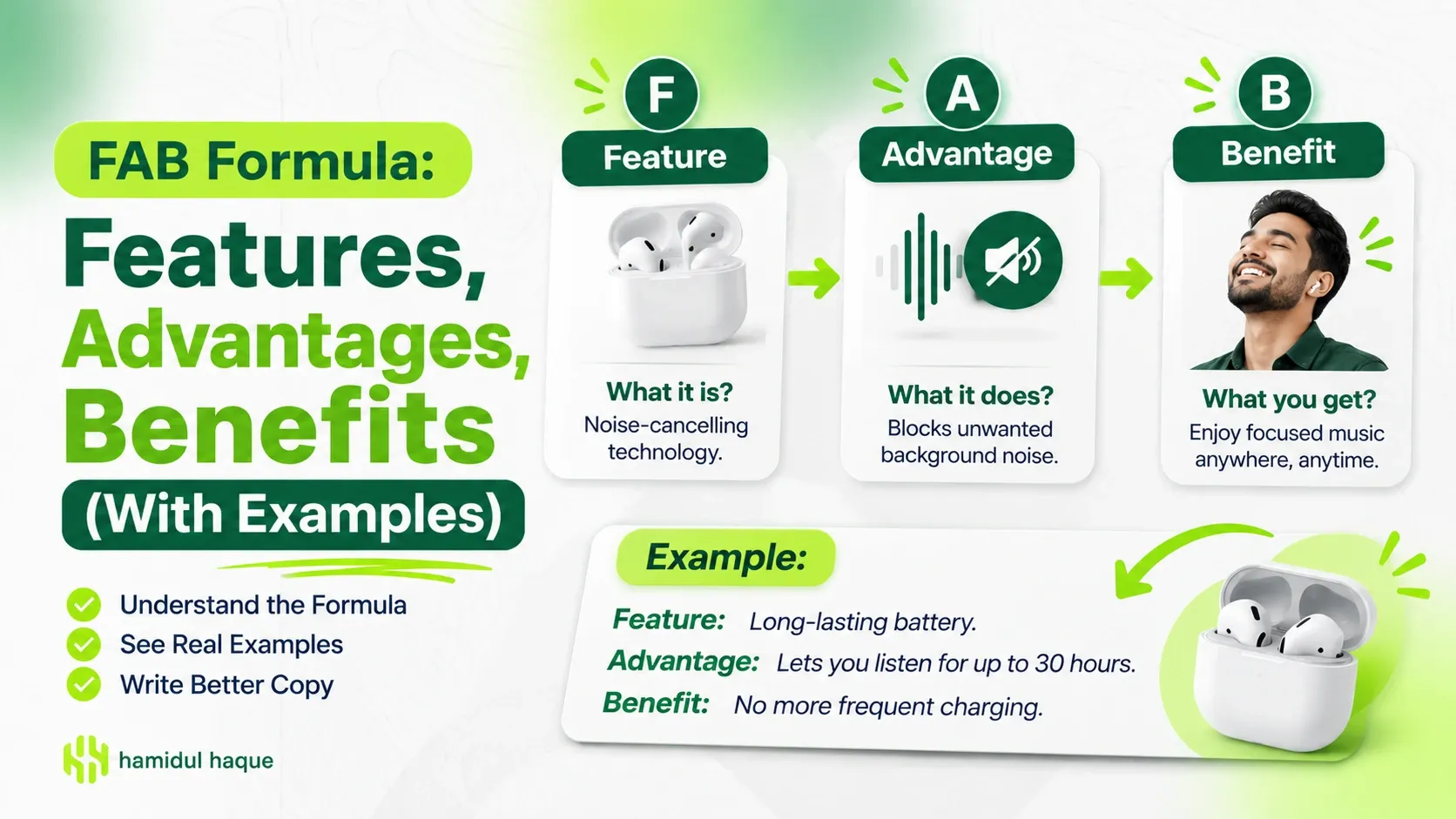
FAB is a copywriting and sales formula with three parts: Features, Advantages, Benefits. It takes a fact about your product and translates it into what that fact means for the person reading.
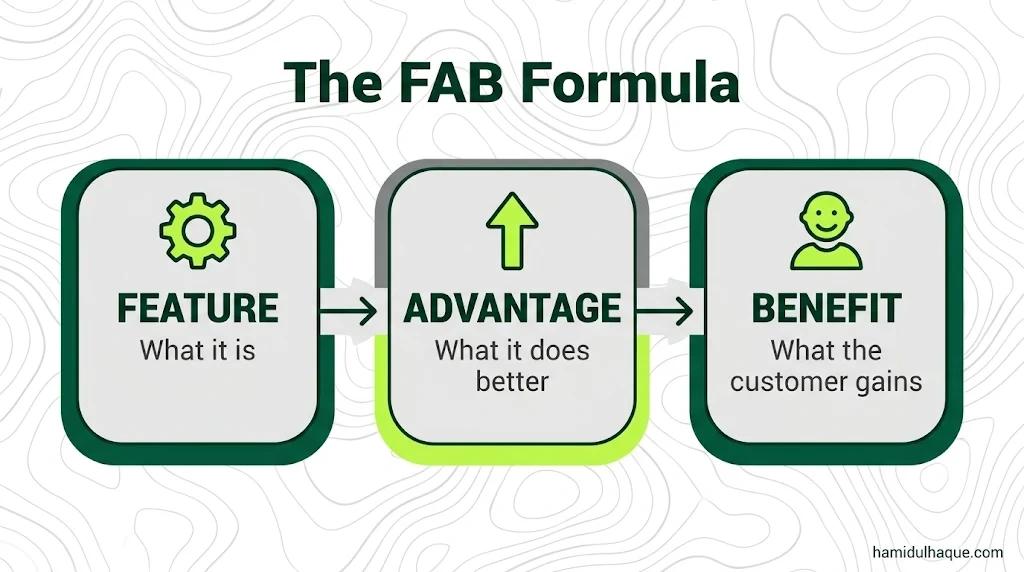
| Part | Question it answers | Example |
|---|---|---|
| Feature | What is it or what does it have? | Offline mode |
| Advantage | What does it do better? | Works without a signal |
| Benefit | What's in it for me? | Read your notes anywhere, even on a plane |
A useful way to remember it: the feature is about the product, the advantage is about the comparison, and the benefit is about the customer.
Features vs Benefits: What's the Difference?
A feature is a fact about the product. A benefit is the result the customer gets because of it. Features answer "What is it?" Benefits answer "What's in it for me?"
| Feature (about the product) | Benefit (about the customer) |
|---|---|
| 256-bit encryption | Your client data stays private and secure |
| Unlimited projects | Take on new clients without upgrading your plan |
| Memory foam insole | Stay comfortable on your feet all day |
| 24/7 live chat support | Get help the moment something breaks, even at night |
There's a well-known marketing line that sums this up: people don't want a quarter-inch drill, they want a quarter-inch hole. It's usually credited to Harvard professor Theodore Levitt, but Quote Investigator traced a version of it back to a 1942 newspaper ad, and Levitt himself attributed it to someone else. Whoever said it first, the point stands: customers buy outcomes, not specifications.
Why the FAB Formula Works
FAB works because it does the translation for the reader. Most visitors won't stop to work out what "auto-sync across devices" means for their day. If you tell them, "Start a note on your phone and finish it on your laptop," they don't have to.
It also keeps you honest. Every benefit has to be traced back to a real feature, so FAB copy tends to be specific and believable instead of vague and inflated.
How to Use the FAB Formula in 3 Steps
1. List the Features
Write down every meaningful feature: what the product has, does or includes. Be concrete. "Fast" isn't a feature; "loads in under one second" is.
2. Find the Advantage
For each feature, ask: what does this do better than the alternative? The alternative might be a competitor, the old way of doing things, or doing nothing at all.
3. Ask "So What?" Until You Reach the Benefit
Read the advantage out loud and ask, "So what?" Keep asking until you reach something the reader genuinely cares about: time, money, stress, status, health or safety.
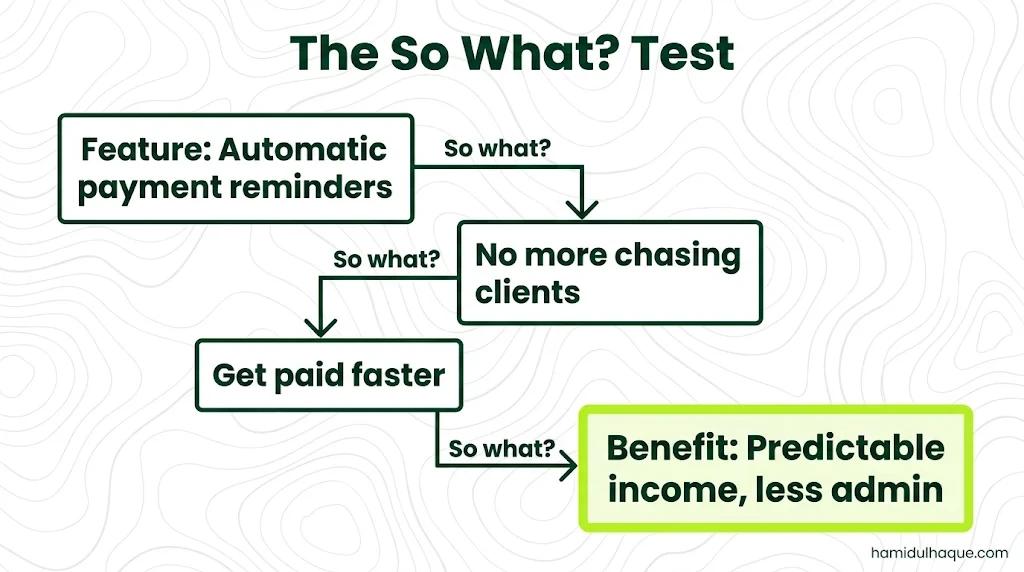
For example:
- Feature: The app sends automatic payment reminders.
- So what? You don't have to chase clients yourself.
- So what? You get paid faster without awkward emails.
- Benefit: More predictable income and less time on admin.
7 FAB Formula Examples
Each example below uses a fictional product so you can see the structure clearly.
FAB Example for a SaaS Product
Feature: Automatic payment reminders.
Advantage: Follows up on late invoices without you writing a single email.
Benefit: You get paid faster and spend your evenings on work, not admin.
FAB Example for an Ecommerce Product
Feature: Merino wool lining.
Advantage: Regulates temperature and resists odour better than cotton.
Benefit: Your feet stay comfortable from the morning commute to the evening walk home.
FAB Example for a Service Page
Feature: A fixed-price website audit delivered in five working days.
Advantage: You know the cost and timeline before you commit.
Benefit: You can fix what's losing you leads this month, without an open-ended invoice.
FAB Example for a Physical Product
Feature: 20,000 mAh battery.
Advantage: Charges a typical phone four to five times.
Benefit: A long weekend away without hunting for a socket.
FAB Example for a B2B Product
Feature: Single sign-on with your existing company accounts.
Advantage: No new passwords for staff to manage.
Benefit: Faster rollout, fewer IT tickets and one less security risk.
FAB Example for a Mobile App
Feature: Offline mode.
Advantage: Works without a signal.
Benefit: Read your notes on the plane, on the train or anywhere the Wi-Fi fails.
FAB Example for an Online Course
Feature: 30 short video lessons under 10 minutes each.
Advantage: Easier to fit into a busy day than long lectures.
Benefit: You actually finish the course and use the skill at work.
Get the Free FAB Template
A Google Sheet for turning features into benefits, with the 'so what?' prompts and all 7 examples from this guide. Make your own copy and reuse it for every product.
Copy the Template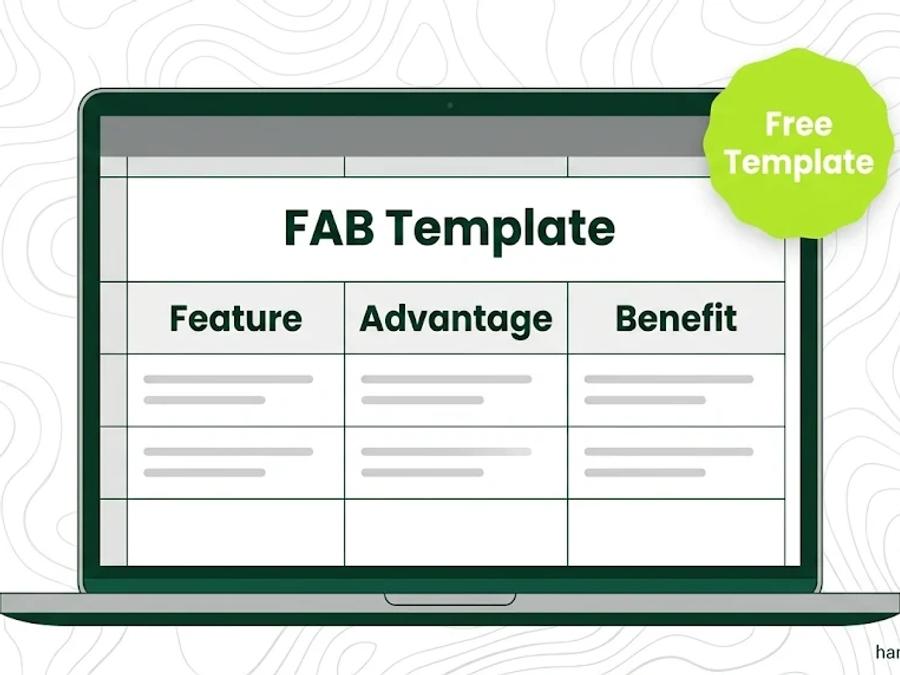
Free FAB Template
Use this table to turn your own features into benefits. Write one feature per row, then fill in the advantage and benefit.
| Feature | Advantage (what it does better) | Benefit (what the reader gains) |
|---|---|---|
| ... | ... | ... |
| ... | ... | ... |
| ... | ... | ... |
Where to Use the FAB Formula
FAB works anywhere you need to explain a product or service quickly:
- Product pages and product descriptions, where specifications tend to take over.
- Feature sections on landing pages, under each feature heading.
- Sales emails, to explain one key feature per email.
- Pricing pages, to show what each plan actually gives the buyer.
- Sales conversations, to answer "Why should I care?" before it's asked.
On a full landing page, FAB fits naturally inside a larger structure. The AIDA formula gives you the overall order, and FAB powers the Desire stage, where features need to become reasons to buy.
FAB vs AIDA vs PAS
| Formula | Focus | Best for |
|---|---|---|
| FAB (Features, Advantages, Benefits) | Explaining what the product means for the buyer | Product pages, feature sections, sales emails |
| AIDA (Attention, Interest, Desire, Action) | Moving a cold reader to action | Landing pages, ads, cold emails |
| PAS (Problem, Agitate, Solution) | Starting from a pain the reader feels | Problem-aware readers, service pages |
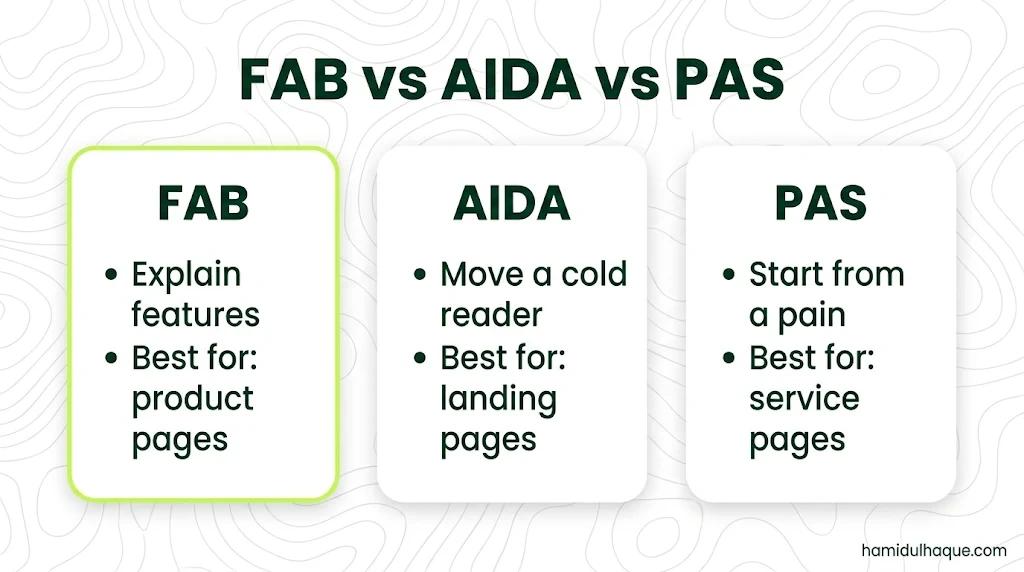
If you're writing for a reader who already feels a specific pain, the PAS formula is often a stronger opener. For the full list, see my guide to 20+ copywriting formulas.
Common FAB Mistakes
- Stopping at the advantage. "Faster than competitors" is still about the product. Push one step further to what the reader gains.
- Inventing benefits. Every benefit has to be traceable to a real feature. If you can't back it up, cut it.
- Listing every feature. Pick the three to five features that matter most to your buyer and go deep on those.
- Generic benefits. "Save time" is weak. "Send invoices in 30 seconds instead of 10 minutes" is strong.
- Forgetting proof. A benefit is a claim. Back it with a number, a review or a demonstration where you can.
Final Thoughts
FAB is one of the simplest formulas in copywriting, and one of the most useful. Take any feature, find what makes it better, then keep asking "so what?" until you reach something your reader cares about.
Copy the free template and run your product page through it today. Before you publish, check the page against my website copy checklist, and if you'd like help turning your product into copy that sells, take a look at my SEO copywriting service.


 Hamidul Haque
 Nov 12, 2026