A visitor lands on your homepage, reads one line and decides whether to stay. That line is usually your value proposition. If it is vague ("innovative solutions for modern teams"), they leave. If it tells them exactly what they get and why you are the better choice, they keep reading.
In this guide, you will learn what a value proposition is, the three questions every good one answers, and how to write yours in five steps. You will also see two real homepages broken down line by line, copy-and-paste formulas, and a fill-in template.
What Is a Value Proposition?
A value proposition is a short, clear statement that tells a specific customer what outcome they get from your offer and why they should choose you over the alternatives. It is not a slogan or a mission statement. It is a promise of value, written in the customer's language.
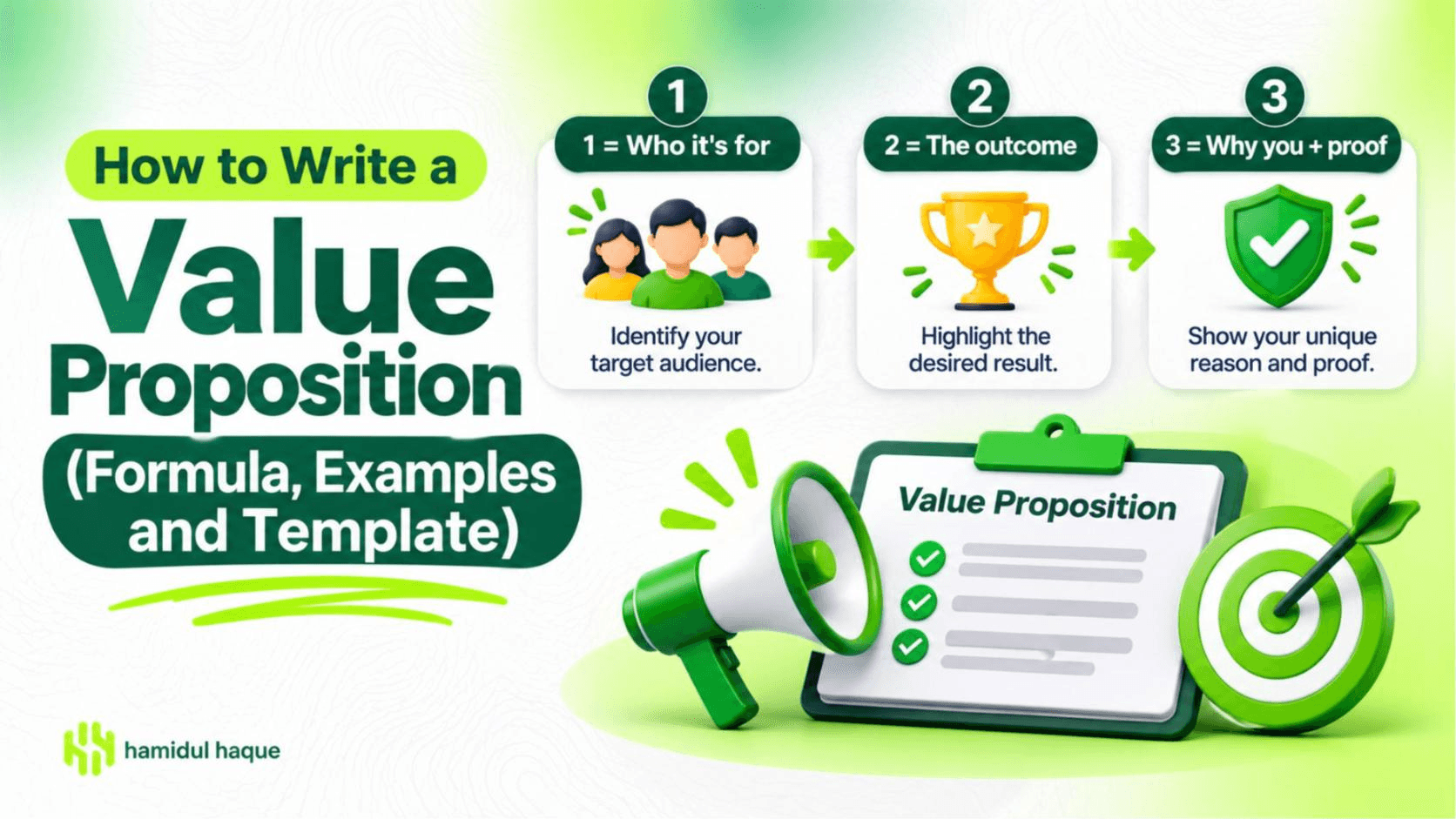
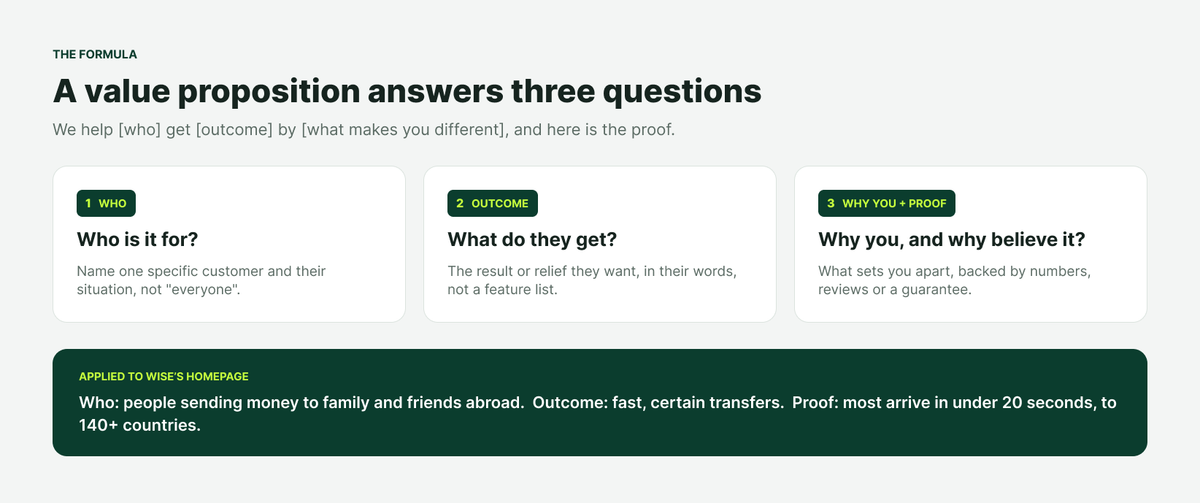
Every strong value proposition answers three questions:
- Who is it for? One specific customer and their situation.
- What do they get? The outcome or relief they want, not a list of features.
- Why you, and why believe it? What sets you apart, backed by proof such as numbers, reviews or a guarantee.
You will usually see a value proposition at the top of a homepage or landing page, but it also shapes ads, sales emails, pitch decks and the answer you give when someone asks, "So what does your company do?"
Value Proposition vs USP vs Tagline vs Positioning Statement
These four terms get mixed up all the time. Here is how they differ:
| Term | What it does | Who sees it | Example style |
|---|---|---|---|
| Value proposition | Explains the outcome a specific customer gets and why you are the better choice | Customers, on your website, ads and sales copy | "The fast way to send money abroad" plus supporting proof |
| USP (unique selling proposition) | Names the one thing only you offer | Customers, often inside the value proposition | "Most transfers arrive in under 20 seconds" |
| Tagline | A short, memorable brand line | Everyone, across brand materials | "Shave time. Shave money." |
| Positioning statement | Defines your target market, category and difference for your own team | Internal: founders, marketers, writers | "For [target], [product] is the [category] that [benefit]" |
In short, your positioning statement guides the team, your value proposition speaks to the customer, your USP is the proof that you are different, and your tagline is the memorable shorthand.
Real Value Proposition Examples, Broken Down
The fastest way to understand a value proposition is to see one working on a real page. Here are two homepages that cover all three questions above the fold.
Calendly
Real example: Calendly's headline names the outcome ("All the work around meetings, handled."), the subheadline explains how it gets there and the benefit ("get the busywork done with fewer tools and less effort"), and the CTA area removes friction with one-click sign-up and "No credit card required."
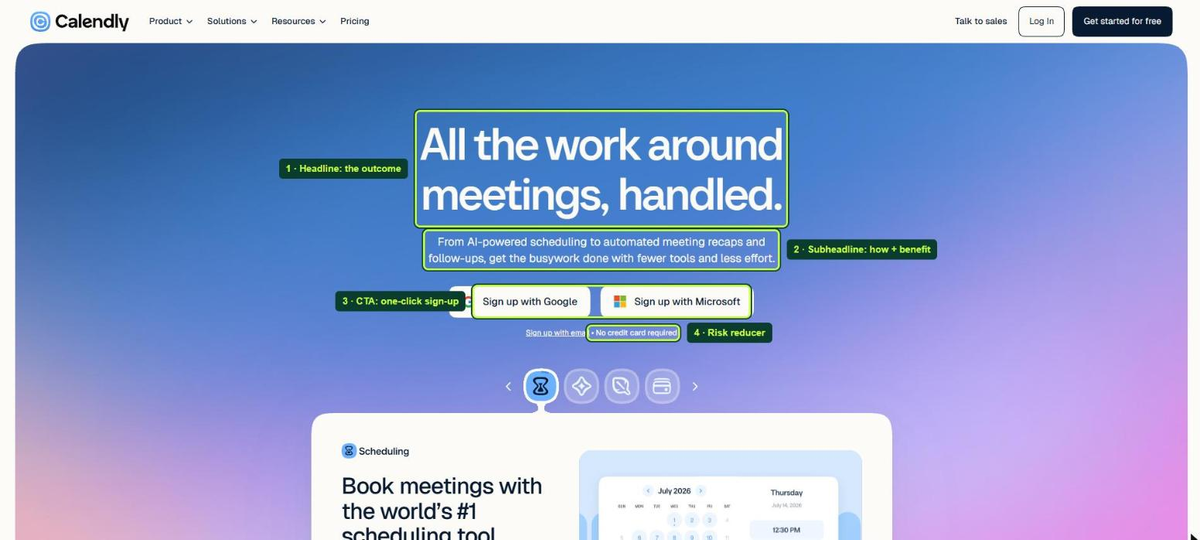
- Headline: sells the result (meetings handled), not the tool.
- Subheadline: connects features (AI scheduling, recaps, follow-ups) to a benefit (less busywork).
- Risk reducer: "No credit card required" answers the first objection before it is asked.
Wise
Real example: Wise leads with a plain outcome ("The fast way to send money abroad"), says who it is for in the first sentence ("Send money to family and friends"), then backs the promise with specific numbers: most transfers arrive in under 20 seconds, and it delivers to 140+ countries.
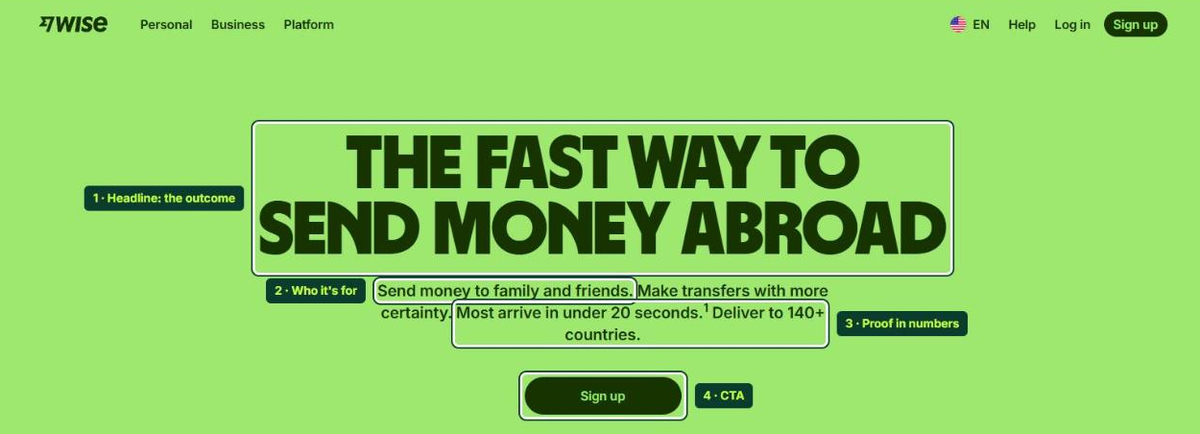
- Specific proof beats adjectives. "Under 20 seconds" is more believable than "lightning fast".
- One clear audience. The first line speaks to people sending money to family and friends, not "everyone".
- One action. A single "Sign up" button follows the promise.
How to Write a Value Proposition in 5 Steps
Here is the process I use when writing homepage and landing page copy for clients.
1. Pick One Customer and One Situation
A value proposition written for everyone persuades no one. Choose the customer you most want to win and describe their situation in a sentence, for example "freelance designers who wait weeks to get paid", not "small businesses".
If you serve several groups, write a separate value proposition for each one and use it on the page, ad or email aimed at that group.
2. List Their Jobs, Pains and Gains
Clayton Christensen's jobs-to-be-done idea is useful here: customers "hire" a product to get a job done. Strategyzer's Value Proposition Canvas builds on the same thinking by mapping three things about your customer:
- Jobs: what they are trying to get done (functional, social and emotional).
- Pains: what annoys them, costs them money or blocks them today.
- Gains: the results and benefits they want.
Write these in your customer's own words. Sales calls, support tickets, reviews of your competitors and Reddit threads are the best sources.
3. Turn Features Into Outcomes
Customers buy what a feature does for them. For every feature, ask "so what?" until you reach a result the customer cares about. "Automatic payment reminders" becomes "get paid without chasing clients". The FAB formula is a simple way to practise this.
4. Name What Makes You Different
List the real alternatives your customer has, including doing nothing or using a spreadsheet. Then pick the one or two things you do better: faster, cheaper, simpler, more specialised, or with less risk. If a competitor could put your sentence on their homepage unchanged, it is not a differentiator yet.
5. Add Proof
A promise without proof reads like marketing. Support your main claim with something specific: a number, a customer result, a rating, a well-known client, a guarantee or a free trial. Wise's "under 20 seconds" and Calendly's "No credit card required" both do this job.
Value Proposition Formulas and Templates
Once you have your notes from the five steps, a formula helps you turn them into a first draft. These are the three I use most:
| Formula | Structure | Best for |
|---|---|---|
| Steve Blank's XYZ | We help [X] do [Y] by doing [Z]. | A one-line statement for pitches and "about" sections |
| Geoffrey Moore's positioning template | For [target customer] who [need], [product] is a [category] that [key benefit]. Unlike [alternative], we [main difference]. | Internal positioning before you write any copy |
| Headline + subheadline + 3 bullets | Headline: the outcome. Subheadline: who it is for and how it works. Bullets: three benefits or proof points. | Homepages and landing pages |
Here is the XYZ formula filled in for a fictional bookkeeping service: "We help freelance designers get paid on time by sending branded invoices and automatic reminders for them."
Free Value Proposition Template (Copy and Fill In)
| Part | Prompt | Your answer |
|---|---|---|
| Customer | Who exactly is this for, and what situation are they in? | |
| Main pain | What frustrates or costs them most today? | |
| Outcome | What result do they get from you, in their words? | |
| Alternatives | What would they use if you did not exist? | |
| Difference | What do you do better than those alternatives? | |
| Proof | What number, review, client or guarantee backs it up? | |
| Headline | The outcome in under 10 words | |
| Subheadline | Who it is for + how it works, in one sentence |
How to Test Your Value Proposition
You are too close to your own product to judge your value proposition fairly. Test it with people who do not know your business:
- The 5-second test: show someone your page for five seconds, then ask what you offer, who it is for and why they would choose you. If they cannot answer, rewrite.
- The swap test: replace your brand name with a competitor's. If the sentence still works, it is too generic.
- The customer test: read it to a real customer and ask, "Is this why you bought?"
- The data test: compare two headlines in ads, emails or an A/B test on your landing page and keep the one that gets more clicks or sign-ups.
Before you publish, answer these yes/no questions:
- Does the first line name an outcome, not a feature?
- Can a stranger tell who it is for?
- Is there at least one specific proof point?
- Would a competitor be unable to use the same sentence?
- Is it free of buzzwords like "innovative", "seamless" and "world-class"?
5 Common Value Proposition Mistakes
- Writing for everyone. Broad audiences lead to bland promises. Pick one customer per page.
- Leading with features. "AI-powered dashboard" says what it is, not what it does for the reader.
- Using buzzwords. Words like "innovative solutions" could describe any company and prove nothing.
- Making claims without proof. "Fastest" or "best" needs a number, a review or a guarantee behind it.
- Hiding it. If visitors have to scroll to understand what you do, many will not. Keep the core promise in the first screen.
Not Sure Your Homepage Says It Clearly?
I review your headline, subheadline and proof the way a new visitor sees them, then show you exactly where the message gets lost and how to fix it.
Get a Conversion Audit
Final Thoughts
A strong value proposition is not clever wording. It is a clear answer to three questions: who it is for, what they get and why they should believe you. Start with one customer, write in their words, turn features into outcomes, name your difference and back it with proof.
Then put it where people will see it: your homepage headline, your ads and your sales emails. If you want to keep going, see how the same promise carries through a full page in my guide to website copywriting, or how to turn it into a clickable headline with the 4 U's formula.


 Hamidul Haque
 Nov 09, 2026