You've written a sales page that explains the product clearly, lists every benefit and ends with a strong button. Visitors still leave. Often the problem isn't the offer. It's that the page skips a step: it pitches before the reader feels understood, or asks for the sale before they believe the solution works. The QUEST formula is a five-step copywriting framework built to fix exactly that.
This guide explains what QUEST stands for, where it comes from, how each stage works with examples, a full worked example, how it compares with AIDA and PAS, and the mistakes to avoid. You'll also get a free Google Sheet to plan your own QUEST copy.
What Is the QUEST Formula?
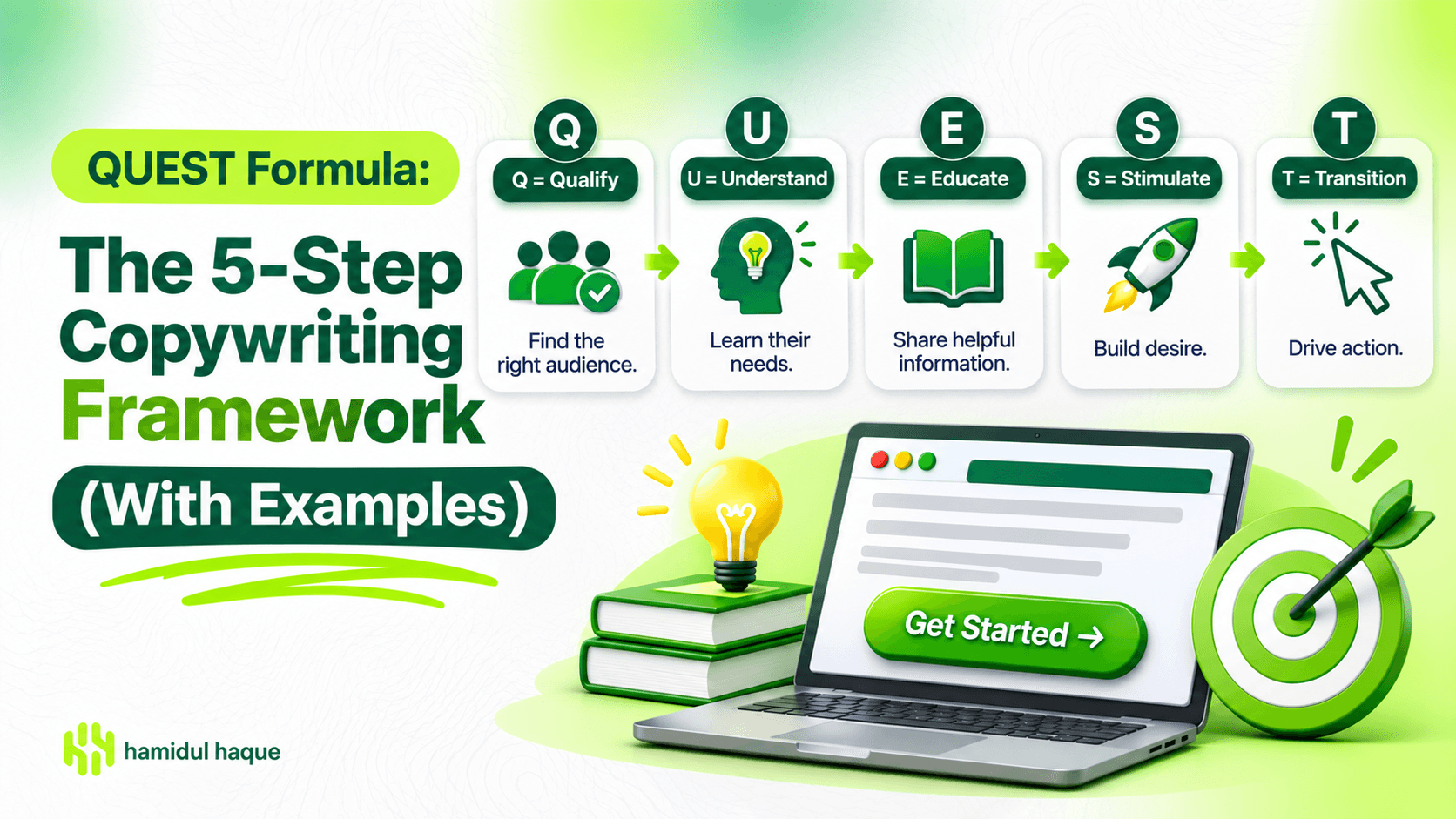
The QUEST formula is a copywriting framework for long-form sales copy. It walks a reader through five stages: Qualify, Understand, Educate, Stimulate and Transition. You first make sure the right person is reading, then show you understand their problem, explain the solution, build desire for your offer, and finally turn that desire into one clear action.
Think of it as a longer, more patient version of the AIDA formula. AIDA works well for an ad or a short page. QUEST is designed for pages where the reader needs more convincing: sales letters, long landing pages, webinar pages, course launches and high-ticket services.
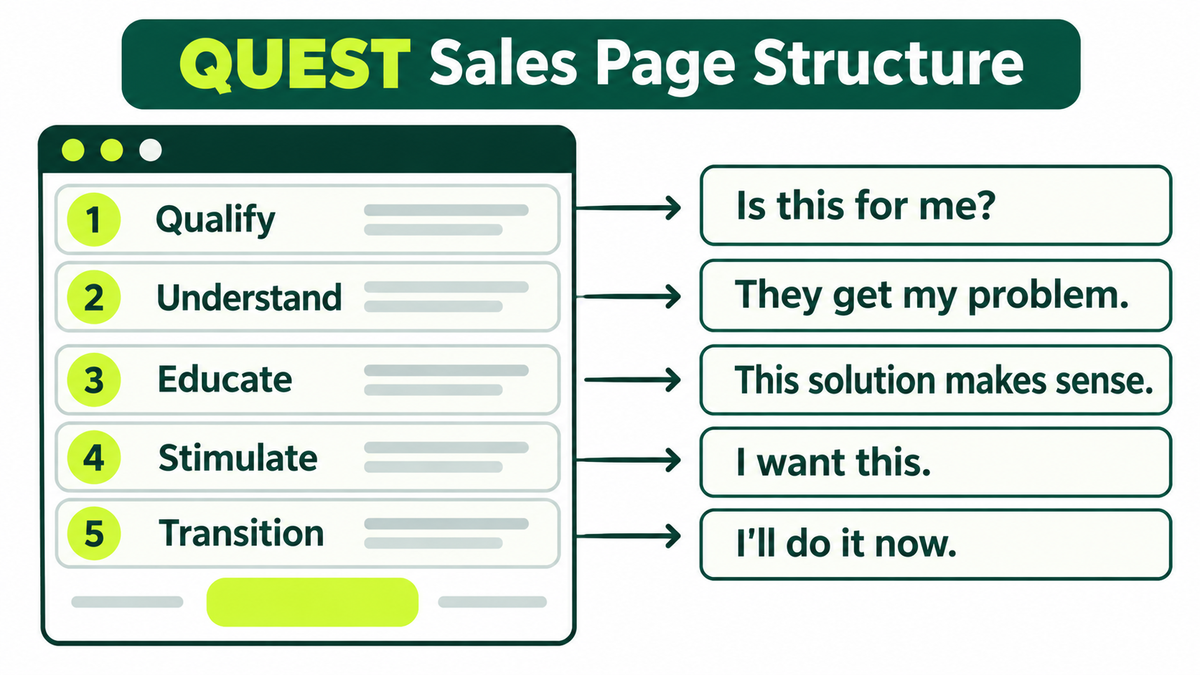
| Stage | What you do | The reader thinks |
|---|---|---|
| Qualify | Call out who the page is for (and who it isn't for) | "This is for me." |
| Understand | Show you understand their problem and its cost | "They get my situation." |
| Educate | Explain the solution and why it works | "That approach makes sense." |
| Stimulate | Build desire with benefits, proof and the offer | "I want this." |
| Transition | Give one clear next step and remove the last risks | "I'll do it now." |
Where the QUEST Formula Comes From
QUEST was created by copywriter Michel Fortin. In his own article on the formula, he says it began in the late 1990s as an acronym he used while teaching professional selling at Algonquin College, and that it became a multi-step approach when he wrote The Death of the Salesletter in 2006.
Fortin describes QUEST as an extension of AIDA rather than a replacement. His summary of the difference is short: "AIDA fit an ad. QUEST fit a full salesletter." The two big changes are that QUEST starts by qualifying the reader instead of just grabbing attention, and that it splits the end of the page into two stages, because desire doesn't automatically turn into action.
The 5 Stages of QUEST Explained (With Examples)
Each stage has one job. If a stage is weak, the reader usually drops off at that point, so it helps to write and review them one at a time. The examples below are for a hypothetical online course that teaches freelance designers to write their own website copy.
1. Qualify
The Qualify stage tells the reader, right away, whether this page is for them. It filters in the people you can help and filters out the people you can't. That sounds like you're losing readers, but the ones who stay read further because the copy feels written for them.
Qualify with the reader's situation, goal or frustration rather than with demographics alone. Fortin's description of the stage is to make the right prospect feel seen fast, and to let wrong-fit prospects filter themselves out.
- Weak: "Learn to write better copy."
- Strong: "For freelance designers who build beautiful websites, then wait weeks for clients to send the words."
Your headline and the first few lines usually do the qualifying. If you need help with that opening line, my guide to the 4 U's formula shows how to make a headline useful and specific.
2. Understand
In the Understand stage, you prove that you know the reader's problem as well as they do, ideally better. Describe the situation in their words, show what it's costing them, and name what happens if nothing changes.
- Weak: "Writing copy is hard."
- Strong: "You've finished the design, but the homepage still says 'Lorem ipsum'. The client keeps promising the copy 'next week'. Meanwhile the launch date slips, your final invoice waits, and the next project is already booked."
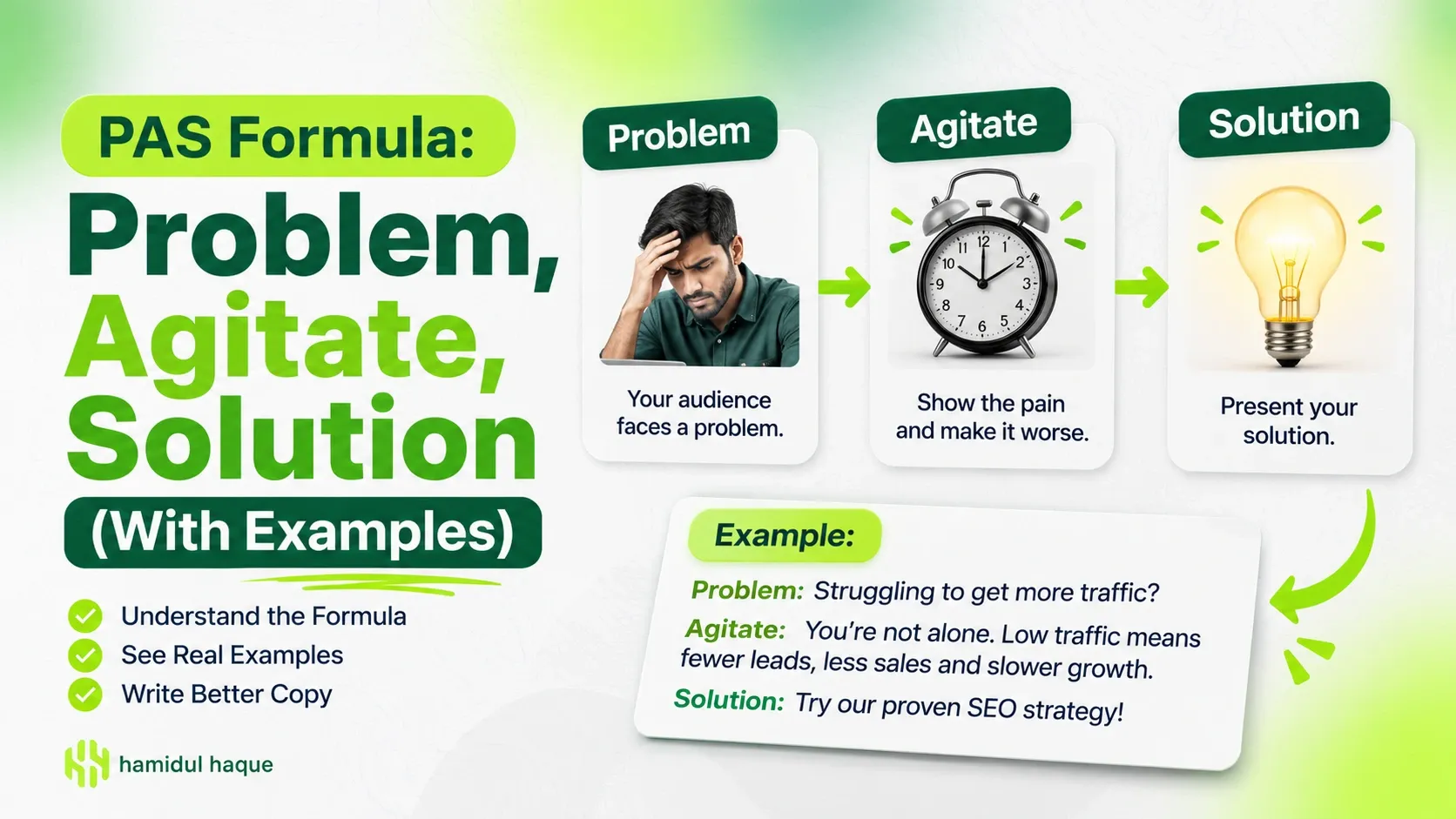
This is similar to the Problem and Agitate steps in the PAS formula, with one difference in tone. Fortin warns that you're not manufacturing urgency here. You're showing empathy, so keep it honest and specific rather than dramatic.
3. Educate
The Educate stage introduces the solution, but not your offer yet. Explain the method, the idea or the approach that solves the problem, and why it works better than what the reader has already tried. This is where you can teach something genuinely useful, share how the method works, show a short case study or explain what makes your approach different.
- Example: "Most website copy fails because it starts with the company instead of the customer. Good copy answers three questions in order: who is this for, what will they get, and why should they believe you? Once you know those answers, each page section almost writes itself."
The goal is for the reader to believe in the solution before they see the price. When you reach the offer, they should already be thinking, "That approach makes sense." A clear value proposition is often the core of this stage.
4. Stimulate
Now you build desire for your specific offer. The Stimulate stage turns the solution into something the reader wants to own. Expand on the benefits, show proof, present the offer and explain why it's worth the price. Fortin says social proof works best here, once the reader understands the solution, rather than at the top of the page.
- Show benefits, not just features. The FAB formula is a quick way to turn each feature into a benefit.
- Add real proof: testimonials, results, screenshots or case studies.
- Present the offer: what's included, the price and any bonuses.
- Help the reader picture life after buying, the way the BAB formula does.
Only use proof you can verify. The FTC's rule on consumer reviews and testimonials explicitly covers fake reviews and testimonials, and invented proof damages trust even when nobody reports it.
5. Transition
The Transition stage moves the reader from "I want this" to "I'm doing this". Many sales pages build desire well and then drop the ball here with a weak or confusing ending. Transition is where you summarise the offer, restate the guarantee, answer the last objections and give one clear call to action.
- Weak: "Contact us to learn more, follow us on social media or browse our other courses."
- Strong: "Join today and write your first homepage this weekend. If the course doesn't help you write it, email me within 30 days for a full refund. [Start the course]"
Give one next step, not several. My list of call to action examples has button and closing lines you can adapt for this stage. Only mention a deadline or limited spots if they're real. Fake countdown timers and false scarcity are among the practices the FTC describes in its report on dark patterns.
QUEST Formula Example: A Full Sales Page Outline
Here's how the five stages fit together for the same hypothetical course. In a real sales page, each stage could be a short section or several screens long, depending on how much the reader already knows.
| Stage | Example copy |
|---|---|
| Qualify | "For freelance designers who build beautiful websites, then wait weeks for clients to send the words." |
| Understand | "The design is done, the homepage still says 'Lorem ipsum', and your final invoice is stuck until the client finds time to write. Every delay pushes back your next project." |
| Educate | "Good website copy answers three questions in order: who it's for, what they'll get and why they should believe you. Learn that structure once and you can write any page." |
| Stimulate | "In six short lessons, you'll learn to write a homepage, an about page and a services page, with fill-in templates for each. Add what your past students actually said, if you have permission to share it." |
| Transition | "Write your first homepage this weekend. 30-day money-back guarantee. [Start the course]" |
Notice that the offer and price don't appear until Stimulate. By then, the reader has recognised themselves, felt understood and accepted the method. That order is the whole point of QUEST.
How to Write Copy With the QUEST Formula
You don't have to write the stages in order, but it helps to plan them in order. Here's a simple process:
- Research the reader first. Collect the exact words customers use to describe their problem, from reviews, sales calls, support emails or forums.
- Write one sentence per stage. Before any long copy, sum up each stage in a single line. If a line is vague, that stage will be weak.
- Decide how long each stage needs to be. A reader who already knows the problem and the solution needs less Qualify and Understand. A cold reader needs all five stages in full.
- Draft the full page, then match each section to a stage. Every section should have one clear job.
- Check the ending. Make sure there's one call to action, the guarantee is clear and the last objections are answered.
Fortin makes the same point about awareness: a buyer who already knows what they want may need very little qualifying, while a cold audience may need a long climb through all five stages. If you know your reader's awareness level, you know where to spend your words. Before you publish, run the page through my website copy checklist.
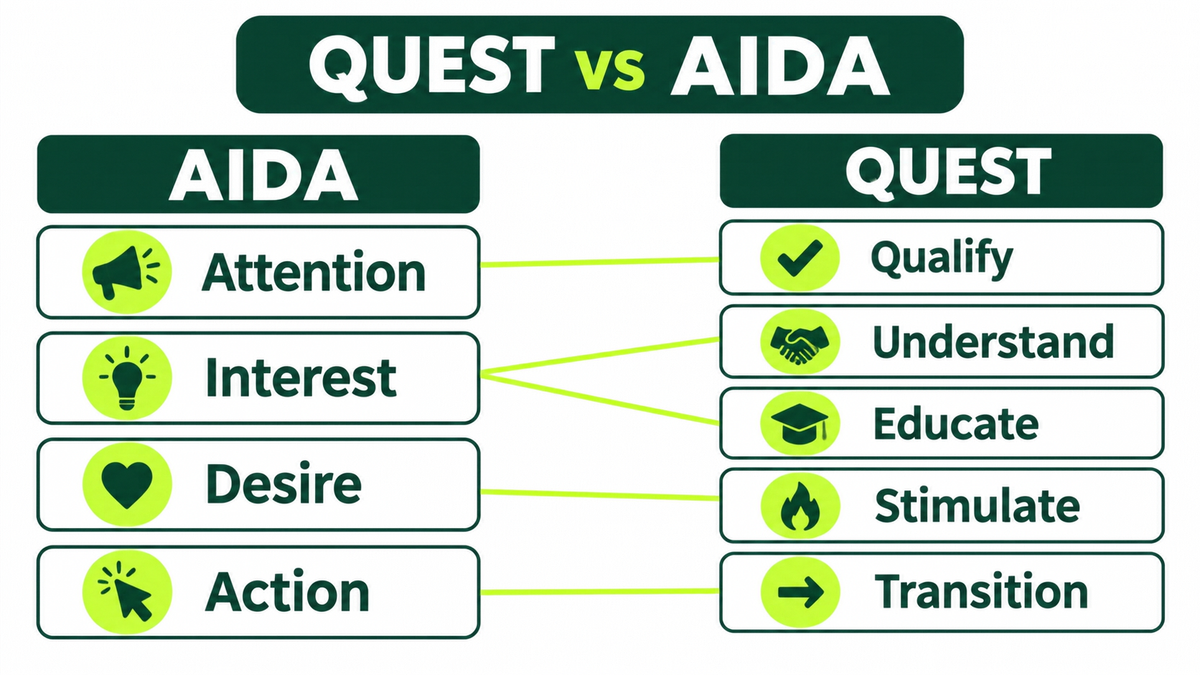
QUEST vs AIDA vs PAS
QUEST isn't the only formula for persuasive copy. Here's how it compares with three common alternatives:
| Formula | Steps | Best for |
|---|---|---|
| QUEST | Qualify, Understand, Educate, Stimulate, Transition | Long sales pages, launches, high-ticket offers |
| AIDA | Attention, Interest, Desire, Action | Ads, short landing pages, emails |
| PAS | Problem, Agitate, Solution | Short copy where the pain is obvious |
| PASTOR | Problem, Amplify, Story, Transformation, Offer, Response | Story-led sales letters |
Use AIDA when you have limited space and a warm audience. Use PAS when the problem is the strongest hook. Use QUEST when the reader needs to trust you and the solution before they'll consider the offer. The PASTOR framework is a good alternative when you have a strong customer story to tell. For a side-by-side of more options, see my full list of copywriting formulas.
Free QUEST Copywriting Template
The template gives you a planning row for each of the five stages with prompts, a goal and a place for your draft copy, plus a final checklist to review the page before you publish. It also includes the worked example from this guide.
Get the Free QUEST Copywriting Template
A Google Sheet with prompts for each QUEST stage, space for your draft copy, the worked example from this guide and a final pre-publish checklist. Make a copy and plan your next sales page.
Copy the Template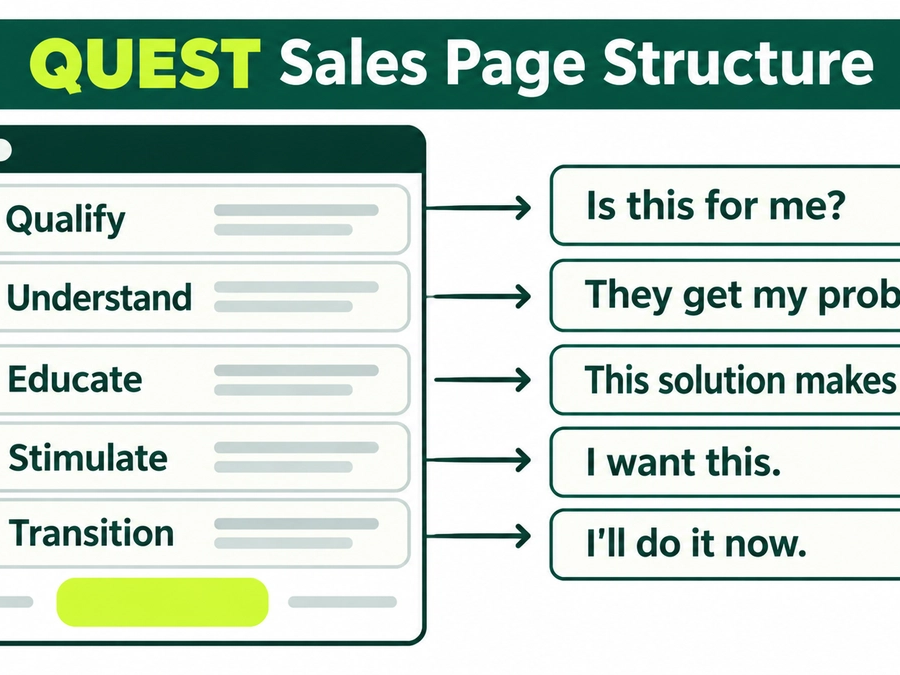
Common QUEST Formula Mistakes
- Skipping Qualify. A generic opening tries to speak to everyone and ends up speaking to no one. Name the reader in the first few lines.
- Over-dramatising the problem. Understand is about empathy, not fear. Exaggerating the pain makes readers sceptical.
- Pitching during Educate. If the offer appears too early, the reader judges the price before they believe in the solution.
- Using weak or fake proof. Vague praise like "Great course!" doesn't build desire, and invented testimonials are a legal and trust risk.
- Ending with several choices. Too many links or buttons in the Transition stage split attention. Give one clear next step.
- Using QUEST for very short copy. For a tweet, a short ad or a subject line, QUEST is too much. A shorter formula or a simple headline test works better.
Final Thoughts
The QUEST formula works because it follows the way people actually decide: first "Is this for me?", then "Do they get my problem?", then "Does this solution work?", then "Do I want it?", and finally "What do I do now?". Answer those questions in that order, honestly and specifically, and your long-form copy will lose fewer readers along the way. Copy the free template and plan your next sales page one stage at a time.
New to copywriting? Start with what copywriting is. If you'd rather have an expert write the page for you, take a look at my SEO copywriting service, or get a conversion audit to see what to fix first.


 Hamidul Haque
 Nov 10, 2026